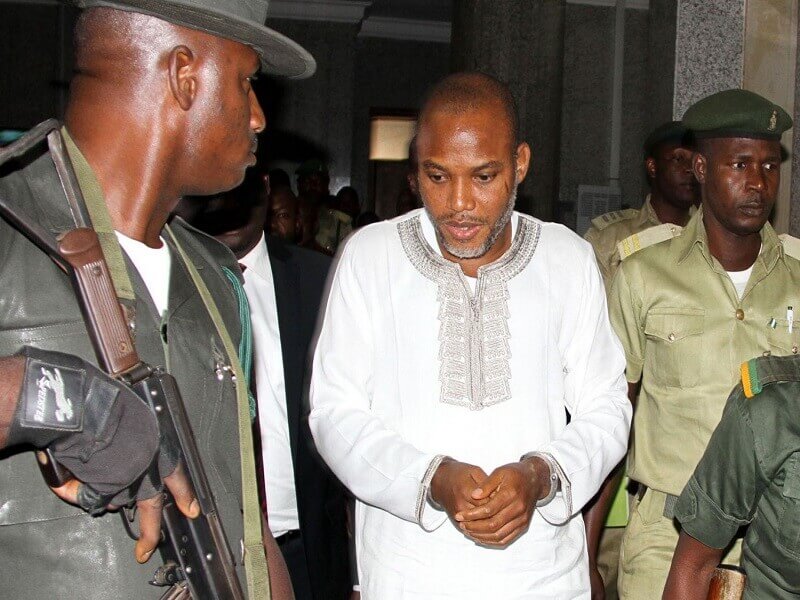
- * As Police Nabs Sowore In Court Premises
- Amnesty Int'l Condemns Restriction Of Media Coverage Of Kanu's Trial
The Federal High Court sitting in Abuja, on Monday, adjourned the trial of Mazi Nnamdi Kanu, the leader of the Indigenous People of Biafra (IPOB).
The trial judge, Justice Binta Nyako, adjourned the trial at the resumption of proceedings at the court in the Federal Capital Territory (FCT).
The trial suffered a setback after the Department of State Services (DSS) failed to produce Kanu in court, according to a report by Channels TV.
Justice Nyako faulted the action of the security outfit, noting that she had stayed back in her chambers waiting for the defendant to be in court.
She asked the prosecution to be diligent with dates whenever she gives one, stressing that it was important for Kanu to be present at his trial.
In his response, the prosecution, Mohammed Abubakar, informed the judge that the defendant was not in court due to logistics reasons.
Kanu’s lawyer, Ifeanyi Ejiofor, on his part, decried that the DSS had denied them access to the defendant for the past eight days. As a result, he urged Justice Nyako to grant the request of his client seeking to be transferred from the DSS custody to the Kuje Correctional Centre in Abuja.
Ejiofor also asked the judge to grant Kanu access to his medical doctor for the purpose of carrying out a comprehensive independent medical examination on him. According to him, “the defendant cannot get a fair trial if he remains in the custody of the DSS.”
After listening to both counsels, Justice Nyako said she would give an order for access to the defendant. She, however, stated that such access would not be free for all, noting that it must be regimented.
The judge also declined the proposal of the defence counsel that Kanu should be transferred to a correctional centre, ordering that he should remain in the custody of the DSS. She, thereafter, adjourned the trial of the defendant to October 21.
Kanu was first arrested in 2015 on charges bordering on terrorism, treasonable felony, and managing an unlawful society. Other allegations levelled against him by the government were the publication of defamatory matters, illegal possession of firearms, and improper importation of goods, among others.
The IPOB leader was initially detained and arraigned in court, but he fled the country in 2017 after he was granted bail for medical reasons. While he was away, he was sighted in Israel and had continued to rally his supporters in Nigeria to achieve the secession of a significant part of Nigeria’s southern region to form the Republic of Biafra.
About four years since he jumped bail, Kanu was intercepted on June 27 this year (2021) and repatriated to Nigeria in an operation conducted by Nigerian security operatives in collaboration with international partners, to face the charges for which he was arrested.
Meanwhile, the police reportedly arrested Sahara Reporters’ co-publisher, Omoyele Sowore, at the Federal High Court in Abuja.
The activist said in a Whatsapp message shared the information with his contacts on Monday.
Sowore was at the Federal High Court in Abuja for the trial of Nnamdi Kanu, the leader of the proscribed Indigenous People of Biafra (IPOB).
Security operatives, comprising the police and operatives of the State Security Service (SSS) had taken over the court premises and the adjoining streets, restricting movements in the area ahead of the trial.
Sowore, among many journalists and others, who had hoped to attend the proceedings were denied entry into the court premises.
Sowore said in a text message on Monday: “I have just been arrested by the Nigerian Police at the Federal High Court. Subjected to beatings by police officers and taken to the Federal Secretariat police station,” he added.
Sowore has been one of the vocal voices condemning the recent re-arrest and repatriation of Kanu to Nigeria. He had called for the unconditional release of the leader of the separatist group, who was said to have been controversially arrested in Kenya, an East African Country.
However, Amnesty International (AI) has condemned the Nigerian authorities for restricting the number of journalists that can report the trial of the leader of Indigenous People of Biafra (IPOB), Nnamdi Kanu, which started on Monday in Abuja.
The International Human Rights group said selecting few journalists to cover the trial is a restriction on access to information and an attempt to deny people the right to know. It also violates all fair hearing guarantees, the group said.
Amnesty International also called on the Nigerian authorities to respect the right to a fair hearing and immediately lift the restriction policy and allow more media outfits unhindered access to the court to do their job.
According to AI, the selecting of few journalists to cover the trial is yet another bizarre and unacceptable attack on the Nigerian media that must not stand. (Source: Channels TV). NNL.