* Says 'If You Don't Write Your Story, Someone Else Will'
By LightRay Media
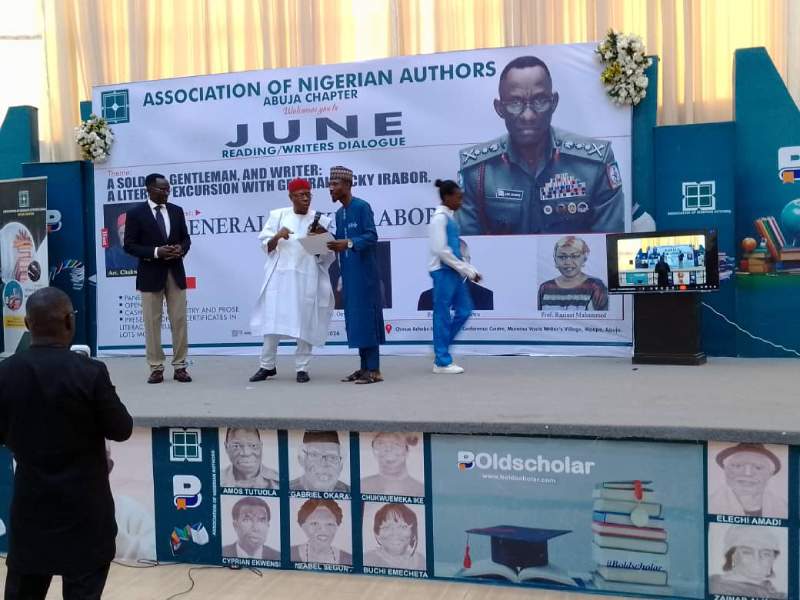
At the Chinua Achebe International Conference Centre in Mamman Vatsa Writers Village, Mpape, a retired Chief of Defence Staff stood before Nigeria’s writers on Saturday evening and made a case that only a soldier could make: the book is more durable than the weapon.
Gen. Lucky E.O. Irabor, rtd. CFR, was the guest speaker at the Association of Nigerian Authors Abuja Chapter May Reading/Writers Dialogue. His theme: A Soldier, Gentleman and Writer. For nearly four decades he wore the Nigerian Army uniform, rising from a second lieutenant commissioned in 1986 to the pinnacle of command. On Saturday, he came with a book instead of a sword.
“Until the lions have their own historians” Irabor opened with the building’s namesake. Chinua Achebe, who founded ANA in 1981, gave Nigerian writers their most urgent instruction: “Until the lions have their own historians, the history of the hunt will always glorify the hunter.”
The retired general said his military career gave him a brutal lesson in why that matters. He was serving with ECOMOG in Sierra Leone the year Nigerian forces secured Freetown. Nigerian troops, he recalled, had cleared the ground and restored order. “Things were, as soldiers say, cool and calm,” he told the room.
Then Chinook helicopters arrived carrying British forces. “A small contingent, no more than a Section of 10 soldiers, was airlifted in,” he said. “They made their way on a road we had already secured. And right there, with a BBC camera crew, they staged their arrival. They moved with theatrical aggression through streets that were already safe. They filmed. They performed liberation for the camera.”
That evening, BBC Focus on Africa told the world British forces had liberated Freetown. “I was furious. Not because I craved recognition. I was furious because it was a lie. And it was a lie the whole world would believe, because the whole world was watching the BBC and nobody was watching us. Nigerian soldiers had bled for that ground. ECOMOG had done the work. And in one evening of careful staging and a camera crew, that truth was erased and replaced with a fiction that served a different story.”
When he returned to Nigeria, Irabor wrote an article titled Price Without Prize for Soja Magazine. “I did not write it because I thought it would change the BBC’s headline. I wrote it because an unrecorded truth is a truth that can be denied,” he said. That incident taught him documentation is not a luxury. “If you do not write your story, someone else will. And they will not write it in your favour.”
SCARS: From battlefield to book That conviction led to his book, SCARS: Nigeria’s Journey and the Boko Haram Conundrum. He said he did not write it to fill retirement. “I wrote it because Nigeria is a country overburdened by unresolved questions about security, identity, and why we keep tearing ourselves apart. I had spent nearly four decades in the middle of those questions, and I had something honest to say about them, so I wrote.”
Boko Haram, he explained, is not the whole story in the book. It is “the entry point, the particular scar I use to trace the larger wound, the deeper, older fractures in our national life that made the insurgency possible and will make the next crisis possible if we do not address them.”
Irabor drew on the metaphor of a scar: “Everybody knows that a scar is not a wound. A wound is still open, still raw, still asking to be treated. A scar is what a wound becomes when it has been survived. It holds the record of the damage and the evidence of the healing in the same skin, at the same time. That is Nigeria. Damaged and surviving. Hurting and enduring. Broken in places and, if we are honest and courageous about it, capable of something better.”
The book, he said, chronicles not just military campaigns but “the human cost — the devastated communities, the widows and orphans, the young lives derailed by ideology and violence.” He called it “not an indictment but an invitation to national soul-searching. It is a call for justice, equity, and a paradigm shift on how we address the roots of insecurity: poverty, poor governance, educational deficits, and the erosion of values.”
Soldier, gentleman, writer Irabor compared the two callings he has lived. He wrote his first article in 1987 for Scorpion Magazine, titled ‘About Turn, Fast!’ — a military command meaning to reverse direction. “An article has a single objective and a defined perimeter. A book has multiple objectives and requires sustained strategic thinking over a long period,” he said.
But the obligation in both, he argued, is identical: honesty. “A soldier is known for discipline, sacrifice and absolute loyalty to a cause higher than him/her. Being called a gentleman… means that you are held to higher standards of honour, integrity, self-restraint and leadership by example, even when off-duty. The soldier who falsifies his report dishonours his mission. By the same token, the writer who falsifies experience dishonours the reader.”
He quoted Ernest Hemingway’s instruction to writers: “Write the truest sentence that you know.” That, he said, was his method: “One true sentence, then another, then another, until the book was done.”
Can the discipline of the soldier coexist with the sensitivity of the writer? Can the firmness of command walk with the tenderness of literature? In a nation “as complex but hopeful, wounded but resilient, as Nigeria,” he believes the answer is yes. “When the identity of a soldier, sworn to defend with his life our national boundaries meets that of the writer interrogating the foundations of our moral boundaries, something remarkable emerges: a citizen who understands both power and restraint; both action and reflection.” He linked that balance to “the gentleman officer… the basis that defines the general epaulettes of sword and laurels.”
The writer’s role in national trust Irabor said Nigerians still imagine soldiers only through conflict: “boots on difficult terrains, commands issued under pressure, strategy shaped in uncertainty, dismissive of bloody civilians.” He referenced the old creed, “Obey before complain,” and the village folklore that soldiers are injected with drugs that make them “act crazy” after training.
Nigeria, he argued, has a trust deficit. “We have institutions that said one thing and did another, governments that made promises in the morning and broke them by afternoon, and leaders who took the nation’s resources and returned nothing but explanations. In that environment, the writer becomes one of the last credible voices, because the writer, at least in principle, has no constituency to protect but the truth.”
He tied security to culture. “In many societies, including ours, security conversations are often isolated from cultural conversations. Yet history teaches us that insecurity is rarely caused only by weapons. It also emerges from social injustice, historical amnesia, broken identities, illiteracy, alienation, and the collapse of shared values.” To separate them, he said, would be absurd. “Therefore, what ANA is doing through such dialogue is not peripheral; it is essential to both the storytellers growth and the nations development.”
Quoting Booker Prize-winner Ben Okri — “a people are as healthy and confident as the stories they tell themselves” — Irabor said Nigeria tells too many incomplete stories. “Too many stories in which the ordinary person is absent, in which the suffering of the North-East and the terrorism and banditry all across the nation are reduced to politics and propaganda, in which the complexity of who we are is flattened into a headline.” A writer’s duty, he said, is to correct that.
The more durable instrument He closed with a contrast that framed his new chapter. “I began my career with a weapon. I am navigating this new chapter of it with a book. And I have come to believe after everything I have seen and everything I have written, that the book is the more durable instrument. Because a weapon ends a conversation. A book begins one. And Nigeria, right now, needs the kinds of conversations that only honest books can start.”
For Irabor, the uniform imposes order while the pen liberates imagination. But “as a gentleman, I must bring the 2 together, to serve the same end: a better Nigeria.”
“I am honoured to be in this room. I am honoured to be called, even in a small measure, an author. I came to the craft late, but I came. And I intend to keep coming,” he told the audience at the Chinua Achebe Centre, before inviting them into what he promised would be “a good conversation this afternoon.”
The dialogue that followed brought together ANA members, panelists, and guests for an interactive session on literature, security, and nation-building — the exact kind of conversation Irabor said Nigeria needs to survive and heal. (source: lightray media). NNL.