By Enyinnaya Appolos
A credible election begins with a credible register. Without it, every other effort, no matter how well-intentioned, rests on a faulty foundation. Therefore, every democracy that seeks to endure, credibility is not optional, it is foundational.
The recent move by the Independent National Electoral Commission (INEC) to revalidate Nigeria’s voter register is not only timely; it is long overdue. It is a bold, corrective, and necessary intervention aimed at restoring integrity to a system that has, for too long, been burdened by distortions, manipulation, and dangerous complacency.
Yet, predictably, some politically biased Nigerians have risen in opposition, armed not with facts or logic, but with a shallow and misleading argument: that because it is called a “Permanent Voter’s Card” (PVC), it should not be subjected to revalidation.
This argument is not only weak; it is intellectually dishonest. It is a narrow, myopic position deliberately skewed to mislead and manipulate public opinion. Rather than engage with the substance of electoral reform, it clings to semantics in a bid to obscure reason and frustrate necessary progress. Such reasoning is not rooted in logic or democratic principles, but in convenience, an attempt to preserve a flawed status quo that benefits from confusion, distortion, and the absence of accountability.
Let us begin by dismantling this flawed premise. The word “permanent” in the context of the voter’s card does not imply immutability. It simply distinguishes the card from the old temporary voting slips issued at the point of registration and used in past elections. “Permanent” refers to durability and reusability, not immunity from review, update, or validation.
If “permanent” truly meant unchangeable, why then has INEC consistently allowed the replacement of lost or damaged cards, the transfer of voter registration from one location to another, and the continuous registration of newly eligible voters? Clearly, the system has always been dynamic. The idea that a register created years ago, under different demographic realities, should remain untouched defies both logic and democratic best practice.
Nothing in governance is static. Systems must evolve to reflect current realities. Elections, more than any other democratic process, demand accuracy, credibility, and trust. Without these, the very essence of democracy is undermined.
One of the most compelling reasons for this revalidation exercise lies in the uncomfortable truth many would rather ignore: Nigeria’s voter register is riddled with inconsistencies. Across the country, there have been credible concerns that names of deceased persons remain on the register, cases of multiple registrations persist, non-Nigerians and underage individuals have found their way into the system, and in some regions, voting figures suspiciously exceed realistic population estimates.
This is not a minor administrative flaw, it is a structural defect with far-reaching political consequences. A bloated or manipulated voter register creates artificial voting strength for certain areas, thereby distorting electoral outcomes. It grants undue advantage to regions where figures have been fraudulently exaggerated, while disadvantaging areas with more accurate data. This is not democracy; it is engineered imbalance.
Revalidation, therefore, is not just about data cleaning, it is about restoring fairness. It is about ensuring that every vote cast reflects a real, living, eligible Nigerian citizen.
Perhaps the most disturbing aspect of an unclean voter register is the continued presence of deceased individuals. While they no longer walk among the living, their names, shockingly, still “participate” in elections. This anomaly opens the door to electoral fraud of the highest order, allowing unscrupulous actors to manipulate outcomes using identities that can neither speak nor contest. INEC’s decision to remove such ineligible entries is not only justified, it is morally imperative.
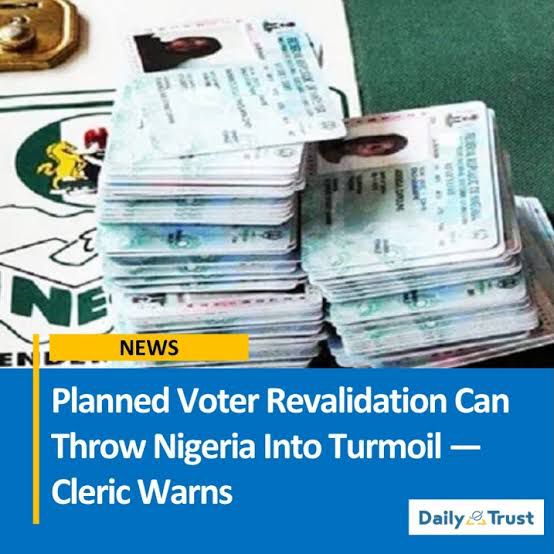
As we already know, this exercise, by INEC, does not invalidate existing voter cards; rather, it strengthens and re-enforces them. INEC has explicitly clarified that this is not a fresh registration exercise, but a process designed to verify existing data, update voter information, eliminate irregularities, and enhance the credibility of the electoral process. Through both online and physical verification channels, the commission is deploying modern biometric tools to ensure that each registered voter is authentic and unique. This aligns with global best practices and reflects a commitment to technological advancement in electoral management.
So why the resistance? The answer is simple: reform threatens advantage. Those who benefit from a flawed system will always resist its correction. Those who rely on inflated numbers, ghost voters, and manipulated registers will naturally oppose any attempt to sanitize the process. But Nigeria cannot, and must not, be held hostage by such interests. This moment demands national responsibility over political convenience.
INEC has outlined a clear program and timetable for this exercise, across polling units nationwide. The process is accessible, inclusive, and designed to accommodate every eligible voter. Nigerians must rise above partisan sentiments and embrace this opportunity. Participation in the revalidation process is not just a civic duty, it is a patriotic obligation.
INEC’s voter card revalidation exercise is a courageous step toward electoral integrity. It deserves not condemnation, but commendation.
Democracy is not defended by slogans or semantics. It is defended by systems that work, systems that are accurate, fair, and trusted. And if revalidation is what it takes to achieve that, then it is not only justified, it is indispensable.
...Enyinna Apolos is a journalist and former media adviser to ex-Abia State governor.