

- * 'He Was A Patriot, Man Of Integrity, Intellect And Leader Of Principle', Says President Ramaphosa
Diagnosed With Cancer In The 1990s, Details Of Cause Of Death Yet Unknown
World Leaders, Global Personalities Mourn
By Celestine Okafor (Editor-in-Chief)
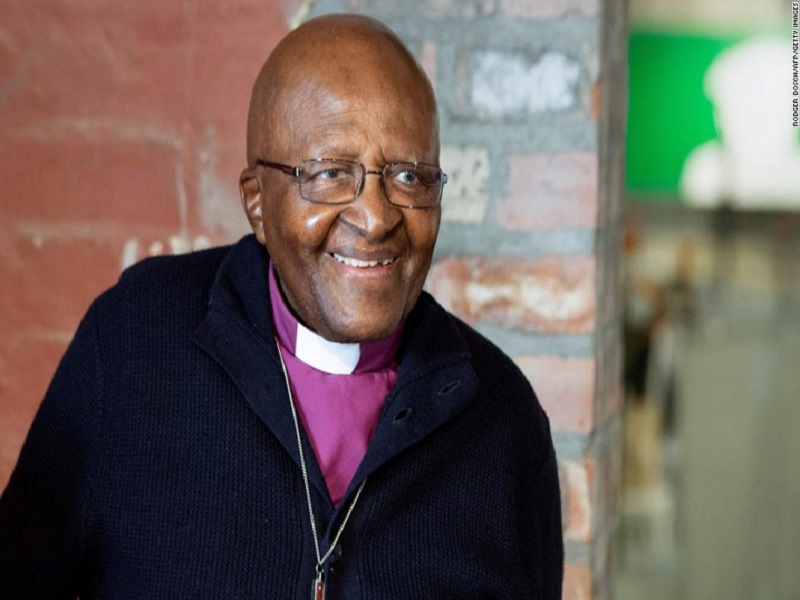
A pall of grief cast over the continent of Africa on Christmas Boxing Day, Sunday, December 26, 2021, as 90 years-old Bishop Desmond Tutu, the former Arch-Bishop of South Africa and renowned anti-apartheid icon, passes on.
No details on the cause of Tutu's death was given by the South Africa Presidency.
The death of Bishop Tutu was announced to the world on Sunday by the President of South Africa, Cyril Ramaphosa. He said in a statement in Cape Town, South Africa's capital, that “The passing of Archbishop Emeritus, Desmond Tutu, is another chapter of bereavement in our nation’s farewell to a generation of outstanding South Africans who have bequeathed us a liberated South Africa".
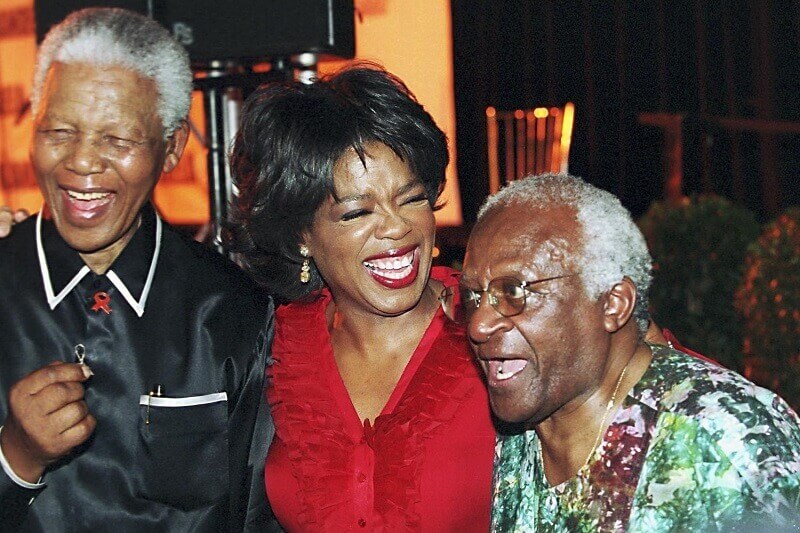 Late Bishop Tutu (Right) With Oprah Winfrey (Middle) And Late Nelson Mandela(Left)
Ramaphosa continued: "Desmond Tutu was a patriot without equal; a leader of principle and pragmatism who gave meaning to the biblical insight that faith without works is dead. A man of extraordinary intellect, integrity and invincibility against the forces of apartheid, he was also tender and vulnerable in his compassion for those who had suffered oppression, injustice and violence under apartheid, and oppressed and downtrodden people around the world.
“As Chairperson of the Truth and Reconciliation Commission, he articulated the universal outrage at the ravages of apartheid and touchingly and profoundly demonstrated the depth of meaning of ubuntu, reconciliation and forgiveness. He placed his extensive academic achievements at the service of our struggle and at the service of the cause for social and economic justice the world over", President Ramaphosa said.
On 20 October 2021, a heartbreaking rumour spread across social media in a matter of hours, claiming that Bishop Tutu had died. This turned out to be a hoax! Various posts, including a Facebook post with over 37,000 views in 24 hours, claimed the rumour to be true.
“The World Would Surely Miss U #RIP Archbishop Desmond Tutu #90yrs,” the post read, alongside a photo of Tutu in his familiar purple robes.
Articles on news sites, like Nigeria’s Naija News, made the same claim, saying Tutu’s death had been confirmed by the Anglican bishop of Johannesburg, Stephen Moreo, on Twitter.
However, in 1984, Arch-Bishop Tutu won the Nobel Peace Prize for his non-violent opposition to apartheid. A decade later, he witnessed the end of that regime and chaired a Truth and Reconciliation Commission, set up to unearth atrocities committed during those dark days. The outspoken Tutu was considered the nation's conscience by both Black and white, an enduring testament to his faith and spirit of reconciliation in a divided nation.
He was diagnosed with prostate cancer in the late 1990s and in recent years, was hospitalised on several occasions to treat infections associated with his cancer treatment.
Bishop Tutu preached against the tyranny of the white minority but his fight for a fairer South Africa never ended, calling the Black political elite to account with as much feistiness as he had the white Afrikaners.
In his final years, he regretted that his dream of a "Rainbow Nation" had yet to come true.
According to a clarification in a statement on behalf of the Tutu family by Dr Ramphela Mamphele, the acting chairperson of the Archbishop Desmond Tutu IP Trust and Co-ordinator of the Office of the Archbishop, "ultimately, at the age of 90, he died peacefully at the Oasis Frail Care Centre in Cape Town this morning".
A frail-looking Tutu was seen in October being wheeled into his former parish at St George's Cathedral in Cape Town, which used to be a safe haven for anti-apartheid activists, for a service marking his 90th birthday.
Dubbed "the moral compass of the nation", Bishop Tutu's courage in defending social justice, even at great cost to himself, always shone through. He often fell out with his erstwhile allies at the ruling African National Congress (ANC) party over their failures to address the poverty and inequalities that they promised to eradicate.
Tutu, just five feet five inches (1.68 metres) tall and with an infectious giggle, travelled tirelessly throughout the 1980s, becoming the face of the anti-apartheid movement abroad while many of the leaders of the rebel ANC such as Nelson Mandela were behind bars.
Although he was born near Johannesburg, he spent most of his later life in Cape Town and led numerous marches and campaigns to end apartheid from St George's front steps, which became known as the "People's Cathedral" and a powerful symbol of democracy.
BISHOP TUTU AS 'A PROPHET AND A PRIEST'
Having officially retired from public life on his 79th birthday, Tutu continued to speak out on a range of moral issues, including accusing the West in 2008 of complicity in Palestinian suffering by remaining silent. In 2013, he declared his support for gay rights, saying he would never "worship a God who is homophobic".
Tributes have however began to pour in from around the world for the man fondly known as "The Arch". The Archbishop of Canterbury, Justin Welby, hailed Tutu as a "a prophet and priest", while flamboyant British billionaire, Richard Branson, said "the world has lost a giant".
UK Prime Minister Boris Johnson noted Tutu's "critical" role in the "struggle to create a new South Africa" and Norway's Prime Minister Jonas Gahr Stoere recalled "a great little man who showed the power of reconciliation and forgiveness".
Bernice King, daughter of Martin Luther King, said: "We are better because he was here," Palestine Liberation Organisation official, Wasel Abu Youssef said Tutu was "one of the biggest supporters" of the Palestinian cause.
Tutu and his long-time friend, Nelson Mandela, lived for a time on the same street in the South African township of Soweto, making Vilakazi Street the only one in the world to host two Nobel Peace Prize winners.
"His most characteristic quality is his readiness to take unpopular positions without fear," Mandela once said of Tutu. "Such independence of mind is vital to a thriving democracy."
At a Boxing Day service at St George’s, the Very Reverend Michael Weeder paid homage to Tutu from the Archbishop's former pulpit, saying it was “once the celebrated point of command” before asking the handful of parishioners present to bow their heads in a moment of silence.
"It is sad, but he was old and served his country very well and it's a very painful loss at a time when there is a leadership crisis in the country and the world," said Ntokozo Mjiyako, a lawyer taking an early morning stroll in Cape Town.
Meanwhile, Nigeria's former President, Chief Olusegun Obasanjo, in his own tribute on Sunday, described the passage of Tutu as a personal loss.
In a condolences letter dated December 26, 2021 and addressed to the President of the Republic of South Africa, Cyril Ramaphosa, at the Union Buildings on Government Avenue in Pretoria, South Africa, Obasanjo wrote that the late Desmond Tutu was a great son of Africa.
Obasanjo said "Tutu was a patriotic and highly respected Teacher, Preacher, Intercessor and Field Commander of the Lord’s Army. He symbolized one of our finest examples of how a life truly dedicated to our Saviour Jesus Christ can make a difference. He had been a difference-maker for his family, his friends, his flock, his community, the Church, the Republic of South Africa and, indeed, the world.
"Over the years, Reverend Tutu had shown focused, credible, bold, sensitive and purposeful leadership not just to members of the Anglican Church but to all Christians. He had been part of building and strengthening the Anglican Church, and its eminent place in the Church system in South Africa today is not unrelated to his selfless service and leadership. Reverend Tutu was acknowledged as a leader among his peers and contemporaries. The Lord was with him and used him mightily to support and supplement his flock.
"Reverend Tutu was an unparalleled visionary leader within the Church with profound knowledge of the Bible and the Word with an admirable, grasp and appreciation of history. He was also a tele-evangelist and a strong believer in the unity of believers worldwide as a transformational tool for development.
"He had very impressive pro-democracy credentials, and was always ready to partner with forces of justice, equity, and fairness universally. I had a personal experience of the way God used him through my relationship and association with him as a man of God. He worked very closely with us in the Commonwealth Eminent Persons Group.
"His insights, understanding and pieces of advice and suggestions on the way forward ending apartheid in South Africa were extremely valuable. He, by himself, was a consummate leader, fearless and quite daring. When most of the political leaders in South Africa were in jail, he was almost a one-man riot using both religion and Holy Bible against apartheid. He was simply like a thorn in the flesh of the white-ruled South Africa’s Nationalist Party.
"At the end of the apartheid regime in South Africa, he was made the Chairperson of the Truth and Reconciliation Commission which laid the groundwork for an enduring and sustainable peace and development in the country, founded on the concepts and principles of human rights, equality, justice and reconciliation.
"Again, I must acknowledge his uncommon solidarity and the deep passion with which he had argued Nigeria’s case for full debt cancellation by the contents of his letter to Mr Gordon Brown, the then United Kingdom’s Chancellor of the Exchequer, during my administration as the President of Nigeria. This heroic advocacy effort of his with respect to Nigeria’s indebtedness to the Paris Club on behalf of Nigeria was very much in his character.
"Though we are saddened by the inevitable finality of his passage, as we will miss his fiery sermons, writings and fatherly counsel, we should be comforted by the fact that he left a good legacy behind and his memory will linger on for very long time in the minds of his admirers, friends, protégés, immediate community, congregants and, indeed, Christendom.
"He will also be remembered for his forthrightness, doggedness, dynamism, welfarism, anti-corruption, estachological discourses, courage, commitment to ethical values, uprightness, unwavering Christian testimony and purposeful leadership. He died with his head lifted high; his ministry untainted; and his integrity uncompromised.
"May the gentle soul of Reverend Tutu rest in perfect peace", Obasanjo mourned. (Additional reports from Reuters). NNL.