


- * Says FG Targets 10 million Artisans For Empowerment In Two Years
By Celestine Okafor (Editor-in-Chief) @CelestineOkaf11
In the second series of the on-going ministerial briefings on the review of performance of President Bola Ahmed Tinubu administration, Nigeria's Minister of Industry, Trade and Investment, Doris Uzoka-Anite, has revealed that some local and foreign investors have already committed to flow in about $30 billion into the Nigeria’s stutaring economy.
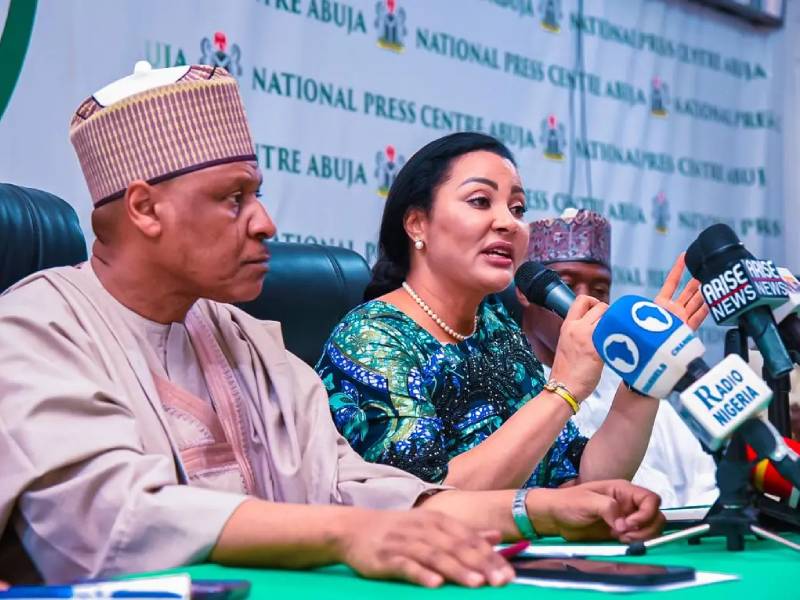
The female minister made this surprise disclosure when she spoke on Friday evening, February 16, 2024, at a Ministerial Press Briefing hosted by the Ministry of Information and National Orientation at the National Press Centre, Radio House, Garki, Abuja. Uzoka-Anite also assured that the said multi-billion dollar expected inflow would be made in the various sectors of the nation's economy.
The minister explained that the over $30 billion investment and many more of such investments were a product of the various bilateral engagements with mostly external investors for partnership opportunities for Nigerian trade and businesses. She also claims that President Bola Ahmed Tinubu's direct diplomatic interventions during his several official trips to countries like India with oil and gas sector stakeholders, certainly was a game changer in the said foreign investment inflows.
Uzoka-Anited said thus: “The Federal Government has secured an investment commitment of $30bn since we came into power eight months ago. It means the investors are going to bring in the money or a promise to bring in the investment. So the money, investment, proposal, and every other thing is done.
“Some have already started building and the investments will come in over a period of five to eight years. Some of the monies will come in the form of equipment, direct investments into manufacturing, and into the facilities. So that fund is here already.
“Our bilateral engagements have been fruitful and have led to significant investment announcements and partnership opportunities for Nigerian trade. A notable example is the G20 summit in India, where a $14bn worth of FDI inflow to Nigeria was announced and being actualised,” she stated.
On another $10 billion investment commitments for the oil and gas sector said to have been secured by the federal government, the Trade and Investment minister said it was a great breakthrough by the Tinubu administration on the basis of which the Confederation of Indian Industries came to Nigeria to explore investment prospects.
She explained that the series of investment interactions with European, African, Asian and Middle East countries like Germany, the Netherlands, South Africa, India and the United Arab Emirates (UAE), etc, have opened investment window and opportunities for investment and the development of collaborative regulatory frameworks.
For instance, Uzoka-Anite disclosed that an expression of interest was received by Nigeria recently from a top steel company in India which committed about $7 billion to the Nigeria's Steel industry. She added that hosting representatives from the oil and gas-free zone also promised an additional investment inflow amounting to $10 billion.
The Nigerian Bottling Company (NBC), the minister said, equally plans to make a fresh huge investment of $1 billion in the next five years. According to the minister, this Investment is aside the over $1.3 billion the company had already invested over the past decade.
She stated that the joint efforts between her Ministry of Industry, Trade and Investment, the Central Bank of Nigeria (CBN), the Ministry of Finance and the Customs to automate the export permit process for increased transparency is presently yielding great fruits. She said this commitment to enhance transparency in the automated process has enabled better auditing and oversight to ensure a proper repatriation of exports.
She also highlighted that On the fuel subsidy policy reforms such as subsidy withdrawal and forex unification, the minister stated that these policy my easures have help to ginger the overall confidence of investors which ultimately fosters job creation, better access to business capital, as well as economic growth.
The minister however remarked on the growing stakeholders concerns about the investments by Shell Petroleum Development Company in Nigeria. She explained that Shell is rather spreading its investments in Nigeria and not withdrawing it's stake as most people wrongly believe. She hinted that Shell is specifically selling it's offshore assets and increasing their investment in the gas and in onshore assets.
She also stated that other milti-national companies operating in Nigeria like Unilever, Coca-Cola, etc, have equally promised to consolidate their local investments, an apparent indication that they still have confidence in the Nigeria's business climate.
Uzoka-Anite said, “I hosted the Managing Director of Shell who came to see me and explained to me the investment plan of Shell. I can tell you they are not leaving, they are rather expanding and increasing their investment in Nigeria. They are selling their offshore assets and increasing their investment in gas and in onshore assets”.
The minister also disclosed at the briefing that the federal government is perfecting plans to empower 10 million artisans across the country over a period of two years
Under the new government's empowerment plan, she said the beneficiary artisans would be trained under the skill-up artisans programme (SUPA) facilitated by the Industrial Training Fund (ITF). She stated that the another one million jobs are being targeted by the government in a talent exchange programme to would ensure job opportunities for Nigerian artisans abroad.
Uzoka-Anite said: "We are creating a National job centre to match available vacancies in industries and businesses with the available talent pool. The job centre will also train and equip people to be job-ready.
“One such initiative is the Skill-UP Artisans program (SUPA) led by our parastatal, the Industrial Training Fund (ITF). The programme will empower artisans with tech-enabled skills training, licensing, access to essential toolkits, and promoting industry-standard excellence.
“SUPA addresses the skills deficiency among artisans and standardizes artisanal practice. The programme ensures the availability of a skilled workforce for domestic industries, thereby reducing labour import dependency. Over a two-year period, the programme aims to empower 10 million hard-working Nigerians and reflects the government’s commitment to promoting economic development and improving citizens’ standard of living, and job creation.
“Still in furtherance of job-creation, skills development and talent exports, we launched the NATEP – to create 1 million jobs, including talent exchange/export, business process outsourcing and job outsourcing. We are engaging and signing MOUs with world-class organizations and governments on this.”
To ensure a smooth trade processes, the minister further revealed that the federal government of Nigeria has already entered a signed agreement with UK authorities that would allow Nigerian businesses to export more goods to their country.
“The partnership also encourages UK investors to explore Nigeria’s most promising sectors, working towards increasing reciprocal Foreign Direct Investment. This cooperation aims to spur economic growth through investments in infrastructure, technology, and manufacturing.
“Furthermore, the Regulatory Cooperation on Technical Barrier to Trade (TBT) makes it easier for Nigeria to trade goods with the UK by preventing, identifying, and eliminating unnecessary technical barriers.”
The ministerial briefing featured some top officials of the government including the Minister of Information and National Orientation, Alhaji Mohammed Idris, who hosted the briefing, as well be as the Special Adviser to the President on Information and Public Engagement, Mr Bayo Onanuga. NNL.