


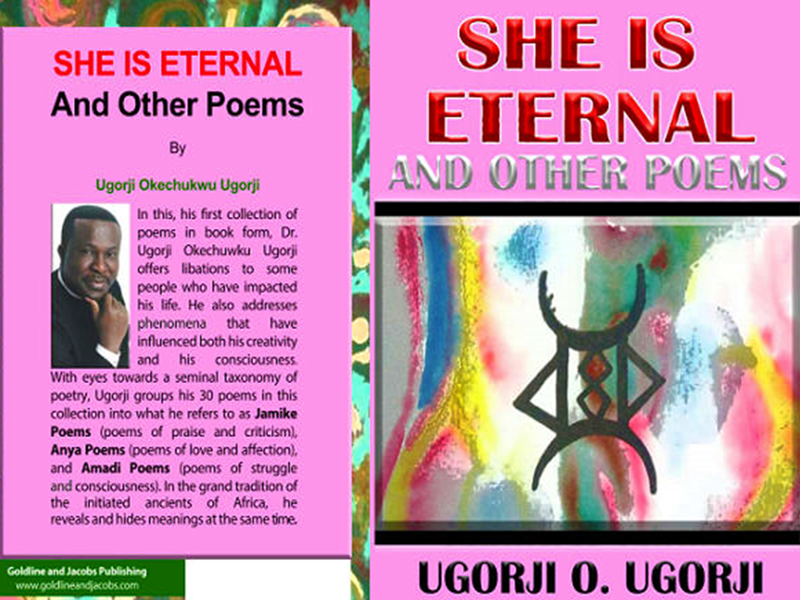

This is an abbreviated review of poetic works presented in She is eternal and other poems, by Dr Ugorji Okechukwu Ugorji. Published in Nigeria by BlueslandCommunications of Abuja, and in the United States of America by Goldline and Jacobs Publishing of New Jersey, the book, 84 pages in pagination, was released in paperback in March of 2020.
Dr. Ugorji has a unique way of writing and uses sometimes complex and sometimes simple techniques to tell stories in the poetry genre. Even in his attempts to share information, he still plays coy with hidden meanings – or more accurately, meanings known to only those well informed about his subjects and objects.
The poems are placed in three provocative segments – provocative in the sense that Dr. Ugorji has the audacity to claim hitherto unknown Igbo-centered agency in the genre of poetry. The segments are:
Jamike poems (which he says are poems of praise and criticisms). Dr Ugorji through the poems in this segment pays tributes to people and ideas that span the globe, for whom the author shows reverence. I will explore some of these poems later in this review, with a degree of knowledge that I am sure will surprise the author and readers alike.
The second segment is referred to as Anya Poems (which the author says are poems of love and affection). The Igbo word for love is “Ihunanya.” The Igbo translation of “I love you” is “Ahurum gi n’anya.” This suggests that for one to love anyone, one’s retina must capture the image of that person. That is why in Igbo land if you see the person you hate, you make sure you avoid eye contact with him/her. Dr. Ugorji uses Anya as the categorical title for his poems of love and affection.
Amadi poems is the third category of poems in She is eternal and other poems. These poems, the author claims, are poems of consciousness and struggles. In this group of poems Dr Ugorji highlights the struggles of African peoples (on the continent and all over the world - now often referred to as the Diaspora). This consciousness was perhaps best captured in the title poem of the book, “She is Eternal.” Perhaps never before has African womanhood been so elegantly extoled in all ramifications, with no gender limitations on their historic contributions to the human story.
Now, let us take a peep into some of the Jamike Poems.
“Orji Ukwu.”
In this poem, the poet gets personal and familial, as he addresses the struggles of his father, Stephen Nwabueze
“Daa Ngozi.”
This is the second ‘Jamike’ poem, which the author used in praising his own mother - a retired nurse who attained the rank of Major in the Nigerian Army before retirement. Ugoeze Ngozi
“Gwuris.”
In this would-be classic, the author salutes and honours a great soldier and son of Lorji, Mbaise, Retired Major General Eugene Nwanguma (a.k.a Gwurieg
“Pat’s Bread”
Here in this poem, Ugorji demonstrates that his reverence is for ordinary folks as well. He pays tribute to another son of Lorji, Mr Patrick Nwanguma
“De Uneze.”
This is an epitaph for late Professor Stephen Uneze Chukwumba from U
For the author, death is the way of all mortals, he beckoned on the deceased uncle to reserve for him a place in the hallowed chambers of the ancestors even as he bid “Dee Uneze” farewell.
“A slow dance.”
This is one of the poems the author grouped under ‘Anya’ poems of love and affection. Here he recounts how he celebrated his 55th birthday with his heartthrob, his jewel of inestimable value, his lovely wife and mother to his six children, Uchenna Ihuaku
His wife Ihuaku wanted to celebrate him in a special way on his birthday, but the author turned down her offers of a Mercedes sports car, trip to Paris, clothes from the famous tailors at Aba, a Spike Lee movie, and others. The celebration eventually kicked off and ended with a slow dance at Willingboro. What he wanted the most from his woman on his 55th birthday was just a dance with her - a slow dance.
And then there is “She is eternal.”
Grouped under ‘Amadi’ poems, this one is a feast to all the senses. Enamored by the strength and beauty of the African woman, the poet goes beyond admiration and ventures headlong and heartlong into veneration and consecration. He took time to describe what his eyes see – ebony, swaggering hips, eyes like “twin dark emeralds,” elegant, intelligent, and sometimes sassy. He speaks of them as life-giving and life-sustaining, like the Igbo deity known as Ala or Ani. He extols their valour in times of war and liberation struggles. You won’t see the name of any woman stated, but those who know their history will recognize the women the poet presents as exemplary in “She is eternal.” For instance, he alludes to Queen Amina of Zaria, Zauzzau who fought and protected her kingdom. He conjures up the image of the Aba Market Women who rose against the white man’s census, with the intention of imposing taxes on women – what is known among the Igbo as “Ogu ndom.”
He goes on to allude to Harriet Tubman and the undergrown railroad, and to Winnie Mandela in Soweto, who held the forth in the struggle against apartheid in South Africa after Nelson Mandela was incarcerated. Then he reminds us of the role women played in the revolutionary war that liberated Haiti from colonial terrorists - Gran AdbarayaToya, woman warrior of Haiti. She was a midwife, and a leader. She trained and fortified others in the act of war, including the founding father of Haiti, Toussaint Louverture.
He alludes to Senator Chris Anyanwu who used her The Sunday Magazine (TSM) to defy General Sani Abacha. He acknowledges the feat achieved by Chioma Opara (nee Ajunwa)
Furthermore, the poet alludes to Mrs. Funmilayo Ransome Kuti
I read all 30 poems contained in the book “She is Eternal and other Poems” and I found them very interesting and fascinating. My first criticism is that the reader requires a deeper knowledge of events in history to fully understand some of the messages embedded in some of the poems. There appears to be a certain deliberate opaqueness that the poet employs. Further, I was disappointment in the fact that there were only 30poems in this collection. In my desire to learn more from the mind of this poet, I felt cheated that there were not more. This, of course, points to the urgency for the poet to write more or release more of what he may already have written. For instance, we are told that his poem, “The Chief Priest’” won him a literary prize in the US, but this particular poem was not included in this current collection. Where is the Chief Priest? Give us the Chief Priest!
Dr. Ugorji Okechukwu Ugorji’s
The reviewer, Mr. Reginald Chiekezi Mbajunwa