



- * It's Causes And Remedies
By Celestine Okafor (Editor-in-Chief) @CelestineOkaf11
It has become a common occurrence that some individuals are in the habit of making costly mistakes of the speech, otherwise known as 'Slip of the Tongue' in clinical psychology. This is an unfortunate situation where people unconsciously say what they did not intend or shouldn't say at all, for obvious implications. The development has somewhat got a lot of guilty individuals into avoidable trouble with others or with the laws of the land. There are several causative factors to this speech error and how it can be remedied, according to experts.
Take the case of Asiwaju Ahmed Bola Tinubu, the 2023 Presidential Candidate of the ruling All Progressives Congress (APC). Last weekend, Tinubu engaged in what many people describe as a speech blunder while speaking at the seventh Kaduna Economic and Investment Summit (KADInvest). Tinubu, who intentionally, might have wanted to shower encomiums on the Kaduna governor for his seeming transformational feats in the state, inadvertently, said Nasir el-Rufai, governor of Kaduna, turned a “rotten situation to a bad one.” He equally added: “I am openly begging governor el-Rufai not to run away from additional degrees like PhD or others. There are educated derelicts". “We are not going to let you run away. Your vision, creativity and resilience in turning a rotten situation to a bad one are necessary at this critical time and that is why we are here", Tinubu reminded the governor.
However, the word, "rotten", according to chambers dictionary and used as an adjective by Bola Tinubu, simply means: putrefied; affected by rot; corrupt; unsound; disintegrating; deplorable bad( collog ) ; miserably out of sorts( collog ), whereas, the word " bad", according to same chamber's dictionary, simply means 'evil; wicked; naughty; hurtful; incorrect; faulty; rotten; poor; unskillful; worthless; unfavorable; painful; unwell; spurious; severe; harmful; offensive; disagreeable; having serious effects'. Therefore, the synonym of 'rotten' is 'bad'. So, if used in it's noun form, it would mean something evil, wicked, hurtful, etc.
However, a US based media scholar, writer and news media columnist, Farooq Kperogi, in his later postmortem on Tinubu's comments, put the APC Presidential gold hope's Chief Campaign spokesman, Bayo Onanuga, on the firing line, for explaining that Tinubu's assumed gaffe was a "a mere Freudian slip, that is not unusual in life, even among leaders of nations". Does Onanuga not know what a Freudian slip is?, Kperogi queried the ace Journalist.
The freelance writer and University Don, Farook Kperogi, gave what looks like his own lexical version of tongue slips when he said: "A Freudian slip is a mistake that unintentionally reveals an uncomfortable truth. In other words, Tinubu actually secretly thinks El-Rufai turns rotten situations into bad ones but only unconsciously revealed it in an unguarded moment". Kperogi added that by implication, Tinubu was actually "... apologizing for betraying the negative thoughts he has about El-Rufai that he'd successfully suppressed before now!".
Here's another case! Obinna and Ngozika (surnames withheld) have been particularly close to each other in recent times. Both young bankers work in the same office. They've been dotting on each other - an indication of a burgeoning intimacy between them. But however, Obinna keeps offending his girl, albeit unconsciously. It happens that each time he wants to call Ngozi's name, he inadvertently calls her by another lady's name. This often infuriates Ngozi and makes her jealous. She began to question Obinna's fidelity and his often professed love for her, accusing him of being intensely in love with another lady at the same time. For Obinna, it was a simple case of a slip of the tongue.
A confidential secretary to the Chief Executive Officer of an Abuja based Computer/Management Consultancy firm who would not be mentioned, ordinarily, is a happy young woman. But the sight of her boss gives her goose pimples. Reason: the man is a perpetual " fault-finder " who scolds and screams at her all the time, sometimes, even in the presence of visitors. This behavior often embarrasses the secretary. One afternoon, an important visitor called at the office to see her boss. The chief executive was taking a short noon hour nap. When the guest asked after the boss, the secretary replied unconsciously that her boss "is silly", instead of saying that her boss was "sitting" in his office. It was an unconscious expression of bitterness towards her boss. Another instance of a slippery tongue!
Stanley, a legislative aide to a Senator in the Nigeria's National Assembly, maintained a very close relationship with his former boss. Stanley is deeply trusted by the lawmaker. Because of Stanley's privileged position with his boss, he became so influential in the affairs and social circle of his employer. He knew so much of his "Oga's" secrets, scandals and deals, as well. Everyone who wanted or needed something from the Senator, courted Stanley's friendship and company in the office and in the Senatorial Constituency of his boss.
But unknown to the Senator, Stanley is the garrulous type. To those who really know him, he could hardly be trusted with vital secrets. In some of his occasional discussions with colleagues, the young man, often and unconsciously, divulges his boss's secrets, just to convince them of his level of influence with the lawmaker. With time, Stanley was found out and his boss eventually suspended and later sacked him. Another victim of slippery tongue.
Zino, unlike Stanley, is a girl easily overwhelmed by her emotions, especially when she is angry. For several weeks running, she had engaged her landlady in a fierce battle over tenancy rights. This mutual war had taken them to virtually every police station in her area command. During one of the occasional hot verbal exchanges of the combatants, Zino unconsciously threatened to organize a mob attack on her landlady, an act which she had actually planned secretly. In a fit of rage, she let the cat out of the bag. Her landlady promptly petitioned the police regarding Zino's threat to her life. Hours later, she was arrested and detained by the police.
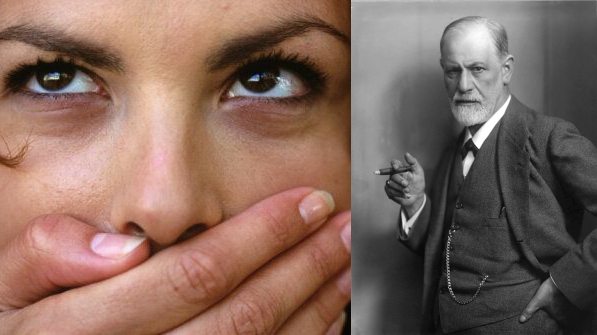
Slips of the tongue otherwise known as Freudian Slips, in clinical psychology, is a common psychological affliction. Specifically, it is a mistake in speech, an accident of speech not necessarily due to ignorance. Freudian Slip or parapraxis, according to https://www.healthline.com, refers to a situation where when you mean to say one thing but you instead say something entirely different. It commonly happens when you're talking but can also occur when typing or writing something down — and even in your memory.
However, towards the end of the 19th Century, a certain elderly Viennese doctor and human behavior scientist, Dr Sigmund Freud, formulated a theory of personality and human development, which became known as psychoanalysis. Freud stated that the human mind consists of three parts which are the conscious, the pre-conscious and the unconscious. The conscious, the neuro physician argued, consists of events which can easily be remembered or recalled. The pre-conscious, according to him, contains information which the human being recall after a little difficulty. While the unconscious, also contains information or events that happened a long time ago and which one can not recall, however hard one tries to do so.
Freud also postulates that each individual's behavior is controlled by three dynamic forces which he identified as the id, ego and the super-ego. The id, Freud said, represents the instructive forces in a person while the super-ego represents the forces that controls an individual's consciousness. The ego, on the other hand, controls the maintenance of the person's reality. It is against this background that Freud explained the totality of the human behavior. Consequently, Sigmund Freud viewed slip of tongue as a very important indication of behavioral patterns.
In Freudian formulation, a slip of the tongue is not an accident, but rather an unconscious wish of what the person actually want. This means that the individual has had the wish, but the wish is either unacceptable to the society or painful to the individual, as a result of which it is expressed in the unconscious mind. But during a normal routine activity, the wish breaks through the barrier of the unconscious and comes to the level of the conscious mind, and gets expressed as a slip of tongue.
The slip of the tongue, however, has significant psychological underpinning for the individual. In psycho-analytic psycho-therapy (that is the study and treatment of the mind ), for instance, the therapist takes note of the patient's slips of tongue during free association technique, when such a patient is asked to voice out whatever comes to his or her mind. The therapist probes the tongue slips deeper in order to get the patient to understand the relevance of the slip of tongue events to the psychological problems the individual or patience is having. This brings about a considerable psychological relief to the patient.
Avoiding a slip of the tongue is very possible, particularly when we're speaking in public. Slips of the tongue are something most people prefer to avoid by preparing a talk that is easy to deliver, by practicing, slowing down in a speech; by engaging with what one is saying; by getting enough sleep, etc, but don't worry if you do make a slip of the tongue, https://learnpublicspeaking.wordpress.com, advises in public speaking skills.
But when individuals discover that they have spoken out of tongue, how really do they feel and how can this psychological anomaly be controlled?
A clinical psychologist based in Wuse 2, Abuja, Dr Micheal Ayu, however, told NIGERIAN NEWSLEADER Newspaper that the occurrence of a slip of the tongue sometimes constitutes an embarrassment to some people, whereas most people do not get so embarrassed because they recognize them as unavoidable mistakes, and not an indication of their inability. Ayu also said that it would not be easy to curb or control the speech slip in an affected individual. "It cannot be controlled or prevented in anyway, since they occur unconsciously ", he stated.
Since the slip of the tongue is part of the speech error, the factor that triggered both of them are the same. Clark and Clark (1977) stated in the https://ejournal.upi.edu that cognitive difficulty, situational anxiety, and social factors are the factors that triggered the speaker to make slips of the tongue. NNL.