CLICK HERE TO GO BACK TO PART 1
 Okadigbo with Former President Olusegun Obasanjo Chatting at a Royal Waiting Lounge at Oslo Airport in Norway.
When that prompting to take a shot at the senate seat of Anambra North came, what gave you that conviction that you will win?
First of all, I think the kind of things that occurred to me and what was actually my campaign slogan and still remains my slogan even as I have sat in other privileged offices is that slogan of to restore the legacy of principled leadership. That was the slogan for my election campaign. And that has been my guiding focus in anything I do. My husband, Chuba Okadigbo, as you already know, was principled. His leadership was principled and for people who didn't understand it, they saw it as arrogance. It was not arrogance. It was doing things and doing it right. Standing on the path of right. I don't care who's ox is gored; just stand there and speak the truth. I remember when I first started in politics, there's some things I would say and my Campaign DG (Director General) would call me and say to me, you don't say those things, and I'm like, what am I supposed to say? Tell them what I know I won't do. But l will tell him it's not possible. I have to tell the people (electorates) what I can do. I want to go to bed and live with my conscience. I'm not going to make promises I can't keep. I have to make promises that I can keep, or promises that I know I'll have to struggle to keep. But the one I can't do, I can't tell them I can do it. It's not possible. So, that, for me, was a driving force. I needed to restore that principle of leadership. That was principle. It's difficult in Nigeria. The temptations are there. Even when you don't want to slap it in their faces, but you have to be able to say, no, I'm not doing this. This is not me. So, that for me, is what drove me. I just felt that my husband, Chuba, didn't leave out what I know he wanted to. He didn't leave it out. No, he didn't.
Was your contribution to the Health Bill in the 7th Senate part of this principled leadership you talked about?
You know, the health system in the country is too poor. As deputy chairman, Senate Committee on Health in the 7th Senate, l and my chairman then Senator Ifeanyi Okowa who later became governor of Delta State, were able to put out the National Health Bill. What has Nigeria done with it? That's a different thing altogether, but we did all that. And we also talked about a percentage of the income of the country going to health, improving the health care system. All this is contained in the National Health Bill. It's all there. So, we worked all throughout that 7th Senate. It was something that was left in previous Senates. But, in our 7th Senate, my committee was able to put it together and place it on the Senate table for the president's assent. And he did. So we have a National Health Bill in 2014.
What were the lessons you have learnt within the period of your elective position?
I must say that the one legacy that I will forever cherish is that I've made friends across the country. I got to understand Nigeria better. In the Senate, even within the committee, you have people from the different regions.or zones. So, it gave me a better understanding of Nigeria and the problems that were man made. A lot of these problems don't necessarily need to exist because we are one happy country. How you know Nigeria is one and even beyond Nigeria is through football match. Nobody cares about whether you're from the North, South, West or East. Everybody's happy, cheering and hailing whoever is the national team. Even when it is not a national team, you will find some people take the side of Chelsea, another one will take the side of Arsenal, another will take the Manchester United. So, what are we fighting and quarreling about? The other day I was watching some of the home videos in this 20 years anniversary of my husband and then he had gone to one of those crisis ridden areas in the north. He was telling them that there's nothing like Christian blood or Muslim blood. Nobody's going to ask you whether it's a Christian or Muslim blood when you're doing the blood transfusion. All you want is to keep this person alive. So I learnt in the Senate that we are one, this country is one. We are one happy people. Nigerians are happy people generally. If you travel abroad, go to a Nigerian party, the happening party in the neighborhood there are usually organised by Nigerians. It doesn't matter whether it's a Yoruba or Ibo party. They call it Naija party. The acronym is a Naija party. You're sure to get your jollof rice there. You're sure to get your Heineken. And Guinness, you'll get it there, too. So that is what Nigeria is all about. Therefore, most of these problems in Nigeria are man made. And I think it also comes from some people feeling marginalised, feeling that they're a less privileged tribe or region not well accommodated and all that. But, like someone once said, what happened to Nigeria we had before all of this? When did it go wrong? What happened? When did we lose it as a nation? And it's still a question, it's still a nagging question in the minds of people when they get together.
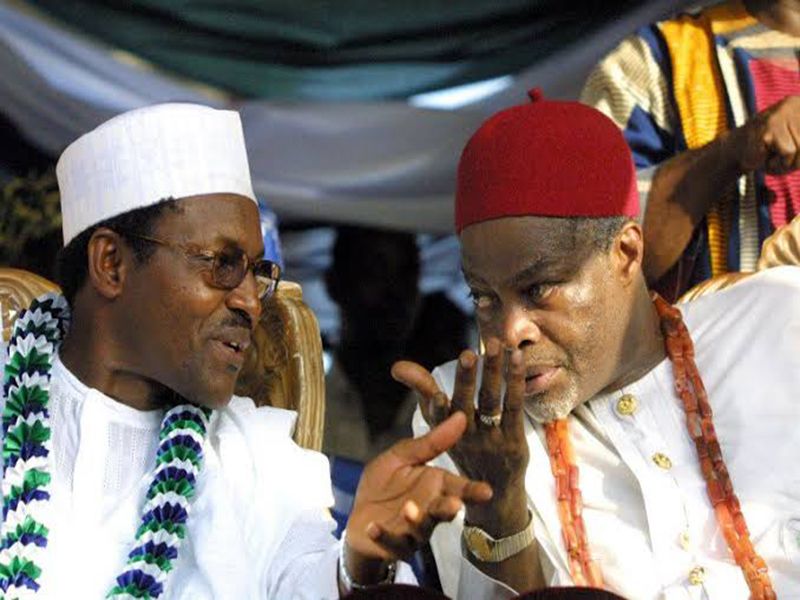 Senator Okadigbo With His Political Ally, Former President Muhammadu Buhari at the Ill-Fated Political Rally In Kano State Where They Were Sprayed With Tear-Gas Cannisters That Led to His Death
Let's talk about the NNPC Limited where you were board chairman. The place is generally seen as a house of corruption. What really has changed while you were there as chairman of the corporation. Would you say that your tenure in NNPC brought some sanity?
I would say again, just like in the case of my going to the Senate, that it was just a destiny call. Destiny call because not even as a young graduate, going through law school, you apply for where you want to work. And I never saw myself applying to work in an oil industry, talk more of sitting as chairman of board of NNPC. That was never my ambition. So, that's why exactly I'm not an engineer. I'm a lawyer by background, even though my profession allows me flex into any situation I find myself. But with NNPC, I didn't see it coming. Not at all. I didn't see it coming when my name was, announced as a director, first of all, and then as events, went on, I found myself again being mentioned as the chairman of the board. That one I didn't even see it coming at all. I didn't even go to bed, wake up and say, Oh, yes, it's possible. No, I didn't even see that coming. It just came. And in this situation, you find yourself philosophical enough to say it is by the grace of God. There's no way l dreamt of being there. I didn't lobby for it. I didn't go anywhere. It just happened. And this is like something anybody would imagine that you would have lobbied. You don't. It didn't happen. But with NNPC, we were going to transit from the NNPC corporation to NNPC Limited. We had the Petroleum Industry Act (PIA), which was the constitution, the roadmap to achieving this. Now, the PIA clearly says that you have 18 months within which to transit from the corporation to a limited company. And this was happening in January when we assumed office. The board was put in place by the then President, Muhammadu Buhari. Now, I took a look at it and said to myself that 18 months will take us to somewhere about February, March or even April of the next year. And we brainstormed about it. We said to ourselves, we have 18 months. Yes!. But what about our financial year? Where do we slot it? Because it has to be a financial year. Either we're doing a mid term or we're doing an end of year. So that was part of the drive that we all had. And we gave ourselves a target. We said let's try and meet this target as a board. We gave ourselves the target. And believe me, we made it in six months. I may be ignorant of the workings of the Oil Corporation but I have done my talk, I've done my research and I'm yet to see any company that has had 19 board meetings in one year. That's what we had in NNPC Limited. We were burning the candle top bottom, to get that six months achieved. And we had a fantastic consulting group. We also had a good management team that were ready to work with me on that. So it was a family but we had to be guided by the corporate governance practices. We had to be guided by that. We walked, burnt the midnight lamp until finally in July (2023), we were able to birth the new NNPC Limited. It came with its own challenges. Even amongst us, we were like, are we sure we're going to make it. But we persevered. It was a lot of work. We stayed guided by the corporate law of governance. It was important that we did that. So board meetings were no easy feat in one year. It's like you're doing these things and you don't even realize that you're so sucked into it. You're doing it and you're trying very hard to do your best. There are times when I had my meltdown, and I'm asking myself, who gave you this job? What are we doing here? But it was a fast learning process. And then, sometimes you find yourself on the international stage talking about something. You've had a crash program, but the words come and then you find that really, it's nothing but the grace of God. So I feel that, sometimes, we have our own angels, teleguiding and putting the words into our mouth for us to say things and all that. And those moments as human beings, we should never take them for granted, because you may come out and say, Oh, I'm a superstar, I'm so intelligent. No, no, no, no, no. Something is behind all of that, l mean your success story.
In essence, you didn't observe the alleged corruption in the NNPC Corporation that people see from the outside?
Well, I tell you honestly, that even me as a Nigerian on the outside did see the NNPC as a place riddled with corruption. Infact, l would join you and others who may hold this view about NNPC to say that yes, it's a "house of corruption". But when you go there, as l did in my capacity as board member and chairman of the Corporation, you will know that those fingers people are pointing at the NNPC are also pointing to them. Now, as part of that "corruption", as Chairman of the Board of that NNPC Limited, one also have to sit up and make sure that things work well there. And, a lot of what people call corruption in NNPC, as far as I'm concerned, just has to do with the way things are done. And that is where you have the streamlining for due process. Sometimes, and even now, I read in the newspapers or hear that, Oh, NNPC is hiring staff, that they're secretly hiring people. And there's no such thing. It's totally fake story! So the wrong impression anyone who reads such falsehood will get is that the NNPC is so corrupt and too secretive. That's an example of the corruption tag on the Corporation in the minds of the public. You won't know the truth unless you're in the inside. You see, there's a process on how these things are done. And like I said to you earlier, the media don't help in all these wrong narratives because there's no investigative journalism being done anymore. There's no investigative journalism. It's like copy and paste. Everybody's facing the same story. Nobody's going to ask, is it really true? Nobody's asking those questions. If you say the refineries haven't worked, yes, they haven't worked, but there's a process on how to get them to work. It's like you take your car to the mechanic, your brake light is showing when you got there, but before you know it, the mechanic is telling you that your fan belt is weak or no more working. He's also telling you that your engine oil is low. He's telling you that even your car windscreen wiper also is weak too. But that's not why you went to his workshop. You went there because your brake light pad was showing red light on the dashboard. So it is with the oil refinery. Some of those things (petrol refineries) have been moribund for years. On the eyesight, I can tell you that all we need to do on those refineries is to change this ring or change this piston or change whatever. it is all Engineering technical terms. But when you open up the refinery plant itself and begin to see the real problems, you will be shocked. So, what do you do? Therefore, if, as Mr President, you gave me or the NNPC Board and Management a timeline of one year or six months to turn-around the refinery and the media just blow it up in their news headlines, when you actually open up the refining machine plant, you find that it's no longer the six months or the one year mandate. You discover that more things have gone bad with the plant. What do I do? How do you go back to the public to tell them that the one year or six months is no longer feasible? And probably you had a budget of 10 Naira. Now you're giving me a problem of 15 or 20 Naira to solve with 10 naira. How do you reconcile that? When you begin to ask for those variations, these are the areas that people come up and say NNPC is a house of corruption. If I say there are 5 piston rings of the refinery plant to change, and I'm going to change piston ring 1, 3, and 4. You may find that 4, you've changed it. Performance becomes optimum. But the other rings that are not changed, you have to change them because otherwise, it's useless changing the ones you've done for you to get an overall performance, optimal performance. You find that you have to, but that was not in your budget. So you come in and say, Oh, it's corruption. So some of these things are a bit over bloated in the media. Corruption in a Corporation like that is something like you have a job to do but in a typical fashion you delay on it, you drag on it because you're expecting somebody to come say thank you. That is corruption. You do your job. That's your job. That's what you're paid for. Not for you to go waiting and dragging things. So, something that may cost us 10 naira, you end up dragging work on it until the cost escalates from what was budgeted for the repair work. NNPC had all kinds of litigation cases, cases that should have been sorted out of court. And that was one area where I came in to get these things resolved, maybe because of my legal background. I said, as much as possible, we should sort some of these cases out of court. I was taught in law school that lawyers don't lose cases, the person who lost case is your client, not you. Because you are ready to go on appeal. And you must be paid. So it is better to settle out of court. Cut off litigation costs. Cut off their aggravation, cut off their unnecessary bitterness, get your clients to face off. A lot of things are resolved from talking. So that was a way I approached things on the NNPC board because I found out that most of these litigation cases came from wrong contract writing. And a lot of people who wrote these contracts have since left NNPC but unfortunately have left NNPC with the burdens of those contracts. Some of these contracts are contracts that could have been sorted out for cheaper cost. But by the time you go to court and then the court slams you all the interest rates and charges and what have you, a case of a thousand dollars becomes a case of a hundred thousand dollars. And these are cases that have lingered for 10 or 15 years. The officers that started these cases are no longer in NNPC. They've since retired. So why don't you solve the problem? Those were some of the changes that our board made at the NNPC.
 Senator Margery Okadigbo (Middle) with Former Deputy Senate President, Ike Ekweremadu and His Wife Beatrice At Okadigbo's Residence in Ogbunike During The Traditional Wedding Of Ego, Chuba's Daughter.
Would you say that your efforts while as Board Chairman of NNPC was appreciated based on the numerous awards and recognitions that came your way?
Well, l think the recognition is something that happened. You are doing what you are doing because you're inspired to do it and because you believe in what you're doing and not that you're expecting anybody to pat you on the back and hail you and all that. You truly want to make a difference in where you find yourself, no matter how small. Even if it's a chairman of XYZ company that is unknown. You do your best because it is your best that will make XYZ become the XYZ. And, that's where I tell you that, for me, service was driven by that legacy to restore principled leadership..That has always been my driving force. Not too long ago, I was honored in an amazing way. I mean, to be given a fellowship by the Institute of Chartered Secretaries and Administrators. That's like you've reached your peak when it comes to administration. Again, I was given the honor of being the one to speak on behalf of the other inductees who were being honored on that day. And I told them that no matter where you find yourself, try always to give your very best because you don't know who is watching. You don't know who you're motivating. All you see is that you're just doing your own thing, but somewhere, somebody is inspired by what you are doing. So for me, the greatest honor too, is when you get recognition from peers. People who probably are even higher than you are, but who accept and say, wow, she's doing a good job and acknowledge that and honor you for that. I think that's the biggest honor anybody can have when you get recognized by your peers. It's a huge thing to be so recognized and that's how I felt. Now on the other side, I get quite a lot of recognition by the women. And I understand that I'm a woman. I would never swap that for anything else. I'll be a woman any day, any time. My next life, I want to be a woman. And when women also say, she is doing well, that also is strong recognition. When women see their own and say, we identify with this woman, it's a strong recognition. I get invited to a lot of talks by women. And.even for the female engineers, I've had some of them ask me, are you an engineer? I say, have you ever seen me in your classroom or did you see me in your engineering forum? I'm a lawyer by profession. It's not about being an engineer or being a lawyer and everything. It's being a woman. Understanding that there are certain things and certain.qualities that we as women share. And one of them, which is a big thing, is to encourage each other. Encourage each other, pat the woman on the back. Let her know that you're with her. You support her. And that goes a long way in putting us women out.
Aren't you sounding like a feminist with this seeming radical gender outpouring (general laughter)?
No no no, honestly, I'm not! I'm not being a feminist, but I've since discovered, to be honest with you, Celestine, that women make better administrators.
Than men, of course...(another general laughter)?
No, don't put words into my mouth (another laughter) But that's not unexpected because it starts from the home. Even where you have children, girl child, male child, you find that your girl child is always the little mommy in the house. She's the one who takes over with her brothers, even older brothers. She's always the one guiding the boys, telling them lets do it this way, go this way, and all that. It just comes natural. It's a natural thing with women. You know, it's an instinctive thing that women are better administrators. They have better listening ear and all what not. Even in NNPC, while I was there, I became Mama NNPC. I was surprised when we had one of the senior manager in a town hall meeting and to my greatest surprise, I was baptized Mama NNPC by the people. And, you know, it just goes to show something. It's very endearing for you to know and feel that people see you as maternal, that they can come to you with their problems. For me, the important thing is to be able to say something and be seen to mean what you say. And for the people I'm talking to, it's for them to say that yes, in everything she says, there is the truth to it. And that's it. That, for me, is very important. It's very important to be held by my word, based on my truth. It's very important to me.
 Chuba Okadigbo with His Little Child.
Okay, when are we expecting your memoir?
Well, the month of October of every year is usually my birthday period. I was hoping that I could do it during the period. You just heard my catalogue of events. I've been so busy. I'm hoping l will find the time. So many things have been said. Even with the late Chuba (Okadigbo) a lot of things about Nigeria that I know haven't been really put out there. You know, even in 20 years, people will come to me and say it's funny people don't even realize that it was Chuba Okadigbo that made possible the homecoming of the late Ikemba (Dim Chukwuemeka Odimegwu Ojukwu) to Nigeria in 1982 when he was political adviser to former President Shehu Shagari. Everything started with Chuba. He sold the idea to President Shagari, initiated the homecoming process and even went to his exile place in Ivory Coast to bring him back. It was Chuba who, at how old, 37, as Shagari's advisor, called for the true no victor, no vanquished. So let all the warring parties come together. And let's get back to Nigeria that we want. And that's how he came back with the late Dr George Obiozor. And also when you talk about the political party called APGA (All Progressives Grand Alliance), Chuba Okadigbo was very privy to it's formation. Even when the likes of Chief Ralph's Okey Nwosu, Chekwas Okorie and co came from the INEC (Independent National Electoral Commission) office with the INEC certificate for APGA issued by the late Dr Abel Guobadia (then INEC Chairman in 2003), it was to this house (Okadigbo's Asokoro Abuja residence) that they first brought it to show Chuba for his blessing. So when people who don't know the story behind APGA talk about the party, I just look at them and laugh. I say, you guys don't even know how APGA started. There are people who know how it started. But they're not talking. Well, the people who don't know are the ones blowing, making so much noise about APGA. There's so many things that I know, but I'm not a talking type. I'm a very quiet person. I like my life quiet, less controversial. But I'll do my memoir, definitely. I think I owe it to my husband's memory, too, to be able to do that. I'm going to need people like you (Celestine) who have run interviews with him (Chuba Okadigbo) over the years. I'm sure you have your own collections to add. So, that will definitely come. I think it's something that I owe it to his memory to do. We also want to talk about his life and times together, a good documentary on him. It's something that has been worked on for 20 years now. I think we put something together during his burial period. We've been taking a look at it again and see, maybe, areas of adjustments and editing improvement.
Thank you very much for your time, distinguished Senator.
Thank you, Celestine. You've done so well. NNL.