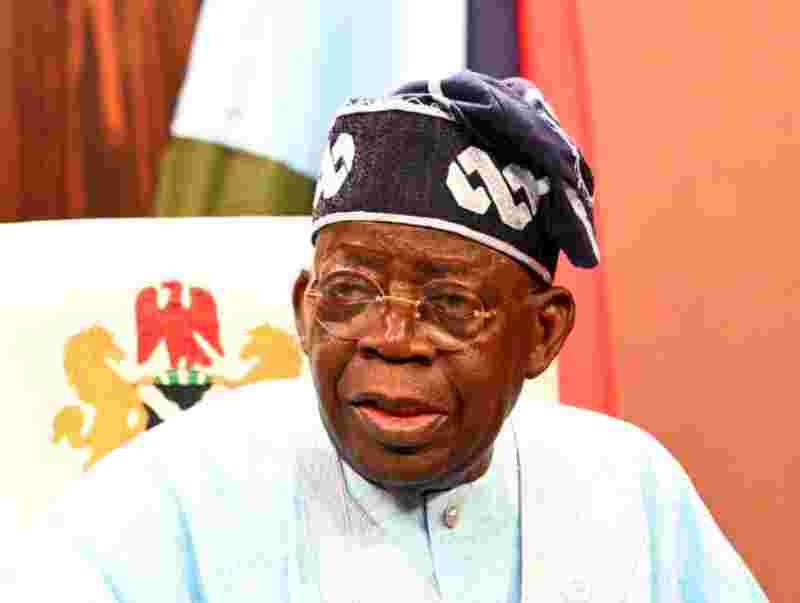
(A NewsLeader Editorial, Thursday, October 8, 2026)
The speculation is increasingly rife and strong, that Nigeria's President, Asiwaju Bola Ahmed Tinubu is critically ill, can't perform important state functions constitutionally exclusive to his office or that of his vice, and may not be able to run for the 2027 presidential election as the presidential flagman of the governing All Progressives Congress (APC).
This claim is still in the realm of rumours! But truth is that Nigeria cannot afford another presidential health crisis wrapped in secrecy, rumour, denials and uncertainty.
That is why the persistent reports of the President's alleged cancer illness and that he is receiving treatment in a private hospital in Lagos deserve neither sensationalism nor dismissal. They deserve verification, and it is entirely the constitutional job of the media to dig out the truth from the maze or haystack of any official secrecy, in the public interest.
The latest allegation, reinforced in recent days by American political commentator Mike Arnold, has once again pushed the President's health to the centre of national conversation. Arnold has made previous claims that President Tinubu is suffering from advanced cancer and has now raised fresh questions about the President's whereabouts, medical condition and ability to remain in office and contest the 2027 presidential election. How true?
The critical point about this claim is that none of these cancer allegations has been established by a medical report, a named doctor, the hospital allegedly treating him, or any other independently verifiable evidence.
This is very fundamental. At the same time, Nigerians should not be told simply to “ignore the rumours” when legitimate questions remain unanswered by professionally experienced Presidential handlers.
It however appears a conclusive reality that the question of whether President Tinubu has returned or not, is answered. Tinubu did return to Nigeria. He departed Paris, France, on September 29, 2026, after an extended European stay and arrived in Lagos the same day. The State House confirmed his return, while Channels Television reported his arrival at the presidential wing of Murtala Muhammed International Airport.
Upon arrival, the President himself addressed the health rumours. He told journalists that he was “healthy, sound, and ready to go”, adding that there was “nothing wrong” with him. But the President did not immediately return to Abuja. He remained in Lagos for six days, during which he delivered his October 1 Independence Day broadcast and participated in other engagements.Then, on Monday, October 5, media reports confirmed that he departed Lagos for Abuja.
As of yesterday, Wednesday, October 7, 2026, the official State House website is publishing presidential statements dated October 6 and 7, 2026, while the Presidency had announced that Tinubu was to present prizes to winners of the NASENI innovation competitions at the State House Banquet Hall in Abuja on October 7. That provides considerably stronger evidence against the assertion that he remained secretly hospitalised in Lagos.
Another important clarification to make is that an official statement issued from Aso Rock does not by itself prove the President's physical location at every moment. The Presidency should understand why Nigerians and journalists are asking for direct, verifiable evidence.
The present rumours of Tinubu's cancer illness has several layers. There have been rumours concerning Tinubu's health since the 2023 presidential campaign. His age, occasional public appearances in which he appeared physically unsteady, his prolonged foreign trips and periods away from public view have repeatedly generated speculation.
In September 2026, those questions intensified during his approximately four-week European stay. Mike Arnold has subsequently alleged that Tinubu has advanced cancer and has questioned whether some of the President's foreign journeys were actually medical trips.
More recently, reports attributed to Arnold have suggested that the President was receiving cancer treatment at a private specialist facility in Lagos. But this is where journalism must draw the line. The existence of a cancer hospital in Lagos does not establish that President Tinubu is receiving treatment there. A presidential convoy, security personnel, a medical specialist's movement or an aircraft movement cannot, by themselves, establish a diagnosis. Indeed, reports on Arnold's latest claims found no verified evidence that Tinubu was receiving cancer treatment at the hospital named in the allegation.
However, the question the Presidency should ask itself is why are the rumours so difficult to kill? Truth is that in an information vacuum, rumours thrive. When a president is visibly active, meets journalists, appears at public functions, travels openly and has a transparent official schedule, speculation about his whereabouts has little oxygen. But when there is prolonged absence, limited access, carefully controlled images, conflicting accounts or official statements that provide only general assurances, rumours acquire a life of their own. This situation is not peculiar to Nigeria. In 2009/2010, It happened to former President Umaru Musa Yar'Adua with devastating consequences.
Yar'Adua left Nigeria for medical treatment in Saudi Arabia in November 2009. His condition was surrounded by secrecy. He was largely inaccessible to Nigerians. And his prolonged absence, coupled with the failure to properly transfer presidential authority, created a constitutional and political crisis. Eventually, the National Assembly invoked the Doctrine of Necessity to make the then Vice President Goodluck Jonathan Acting President. Yar'Adua eventually died in May 2010.
The lesson is not that Tinubu is repeating Yar'Adua's medical history. There is no evidence establishing that. The lesson is that Nigeria has already experienced the consequences of inadequate presidential health communication. We must not repeat the information management failure.
Currently, Nigerians know very little about President Tinubu's health, especially by the standard that ought to apply to the health of a president of a country. It is an official fact that President Tinubu is 74 years old which he publicly marked in March 2026. There have been public reports of physical incidents and health-related speculation. But those observations are not equivalent to a medical diagnosis.
Importantly, in June 2025, while speaking at the inauguration of the African Medical Centre of Excellence in Abuja, Tinubu referred to his own “ordeal as a sick person admitted at the King’s College Hospital in London.” That establishes that he has previously experienced significant illness requiring hospital admission; it does not establish cancer, nor does it establish his present state of health.
There is presently no publicly verified medical report establishing that President Tinubu has cancer ailment or credible publicly available medical evidence establishing that he is currently incapacitated. Conversely, the Presidency has not provided Nigerians with a comprehensive recent medical report that independently demonstrates his overall fitness. Therein actually lies the problem.
However, the question of whether Tinubu is fit to contest the 2027 election should not be answered by Arnold, the opposition politicians, presidential aides, social-media influencers or newspaper editors. It should be answered by medical evidence and the constitutional process.
The 1999 Constitution does not make the absence of cancer a specific qualification for presidential candidacy. Section 131 sets out the constitutional qualifications for election to the Presidency. More importantly, Section 144 provides a constitutional mechanism for determining whether a sitting President has become permanently incapable of performing the functions of office, including examination by a medical panel where the constitutional process is triggered.
Therefore, having cancer would not automatically mean that somebody was constitutionally incapable of being President. The relevant question would be whether the condition rendered the President incapable of performing his constitutional functions.
The 2027 presidential election is scheduled for January 16, 2027, according to INEC's revised timetable now displayed on its official platform. That election is now barely three months away. Consequently, the President's physical and mental fitness is not merely a private family matter. It has become a matter of legitimate national interest, particularly because Nigerians are being asked to decide whether to entrust him with another four-year mandate.
In overall in this present circumstance, the media must investigate and not become the rumour. The media has a right, indeed a responsibility, to investigate the health and whereabouts of a sitting president when there are credible reasons to believe that his capacity to govern may be affected. But journalists cannot manufacture evidence.
It would be unprofessional for a newspaper to publish that “Tinubu has cancer”
when the true scenario is that
someone has alleged that Tinubu has cancer. Those are entirely two different statements.
Responsible journalism requires corroboration, named sources where possible, documentary evidence, a right of reply, medical expertise and clear separation between fact, allegation and inference. The media should also never harass hospitals, stalk doctors, intimidate medical workers or expose private medical records simply to obtain a sensational story. That, of course, would cross the line from public-interest journalism into irresponsible intrusion.
The appropriate investigative questions are different: Where was the President and his official itinerary? When did he depart Lagos and arrive Abuja? What official engagements did he perform and who met him? Is there a constitutional transfer of authority, and has
the Presidency's explanation remained consistent, or is there credible documentary evidence contradicting the official account?
Those questions can be investigated without violating medical confidentiality.
The duty of the Presidency media unit, therefore, is not solve this problem merely by saying that “Mr President is healthy", which, of course, may be true but repeated denials without sufficient transparency can paradoxically strengthen suspicion. The Presidency should adopt a more professional system of presidential health communication by first, publishing periodic physician-certified health summaries, as appropriate and with the President's consent.
Besides, where the President takes an extended medical or personal absence, the Presidency should provide Nigerians with clear information about his official status and who is constitutionally exercising presidential functions. This official itinerary should be updated promptly. And when a major health allegation emerges, the Presidency should respond with facts rather than insults or angry tantrums in some extreme cases. The years of newsroom experiences of the Presidential spokespersons were sufficient to give them a sense of what to do and how journalists react or behave in the course of their news quest during such situation.
As a matter of fact, the Presidency gas a duty to distinguish between the President's legitimate right to medical privacy and the public's legitimate right to know whether the person entrusted with supreme executive authority remains capable of performing his duties. There are international examples.
In other lands like the United States of America, for instance, the presidential health information has traditionally been handled through formal medical statements. Take the case of former President Joe Biden as a case in point. The White House physician released a detailed health summary in February 2024, stating that Biden felt well and was “fit for duty,” while outlining the medical examination and specialist consultations undertaken.
Also, in his time in the White House, former US President, Donald Reagan's administration regularly issued medical reports about him. And following President Ronald Reagan's cancer surgery, the White House publicly reported examinations and test results, including subsequent examinations showing no evidence of cancer recurrence.
Another useful example here is provided in the case of South Africa. When former President Nelson Mandela was hospitalised, the Presidency did not disclose every detail of his medical history, but it regularly issued updates such as “serious but stable” and explained that he was receiving expert medical care. These disclosures simultaneously appealed for public respect for President Mandela's privacy.
Therefore, the challenge now before President Tinubu's reputational aides at the Aso Rock Presidential Villa is to tell the Nigerian public enough about the President health situation to establish the truth; protect the patient's legitimate medical privacy and offer reassuring comments.
Even France where President Tinubu reportedly went for vacation and probably medical checks offers the opposite warning.
When the former President of that European country, Mr Francois Mitterrand's prostate cancer was concealed for years, his personal doctor later revealed that Mitterrand had been diagnosed with cancer in 1981 and that the official medical bulletins did not disclose the true extent of his condition. His doctor eventually argued that by late 1994 the President was no longer capable of properly exercising his office functions.
Also in Zimbabwe, former President Robert Mugabe also faced repeated health speculation surrounding overseas treatment. At various times,the government dismissed reports as false, while later reports established that he had travelled repeatedly to Singapore for medical care.
Nigeria itself has the more recent ex-President Muhammadu Buhari experience.
When Buhari took medical leave in 2017, the Presidency initially faced widespread speculation. Buhari subsequently notified the National Assembly that medical tests required him to extend his stay in London and that Vice-President Yemi Osinbajo would continue to act on his behalf. The important difference was that the constitutional chain of authority was kept clearer.
This administration, therefore, must not repeat the Yar'Adua experience. The presidency should not wait until a President's health becomes so uncertain that governance itself becomes uncertain. The Umaru Yar'Adua experience demonstrated the danger of presidential secrecy. The problem was not merely that Yar'Adua was sick. Presidents are human beings and can become ill. The problem was that the Nigerian state became unable to tell its citizens clearly who was exercising presidential authority and what the President's actual condition was. That is what must never happen again.
Tinubu's situation is not Yar'Adua's situation. There is presently evidence that Tinubu returned from Europe, stayed in Lagos and subsequently travelled to Abuja. There is also continuing official communication issued in his name. The State House has announced presidential engagements in Abuja. But they should not end the conversation about transparency.
NEWSLEADER'S POSITION
NewsLeader therefore rejects two dangerous extremes. The first is rumour masquerading as journalism and the second is official denial presented as transparency. Neither of these two serves Nigeria. If President Tinubu is healthy enough to continue governing, Nigerians deserve confidence based on credible evidence rather than political assurances. And if he is receiving medical treatment, Nigerians deserve to know enough about his capacity to discharge the duties of President without demanding the publication of intimate medical details. While
he is fully capable of contesting the January 16, 2027 presidential election, that should be established through the normal constitutional and electoral processes and not through any form of propaganda. If,
at any time, a medical condition makes him constitutionally incapable of performing the functions of Presidential office, Nigeria's Constitution already provides a mechanism for addressing that circumstance.
What Nigeria does not need is another period in which the President is somewhere and the Presidency says another thing. The news media say something else, social media says something worse, and citizens are left to guess who is telling the truth.
The Presidency should therefore seize the present moment and end the uncertainty once and for all. Show Nigerians that the President is at work. Publish his official engagements. Provide credible physician-certified assurances where appropriate. Keep the Vice-President's constitutional role clear whenever the President is unavailable. And answer legitimate questions without turning every question into an attack on government.
The media, for its part, must investigate without becoming an accomplice to misinformation. The Nigerian people must learn to distinguish evidence from allegation, and investigation from speculation or legitimate public-interest journalism from political propaganda. The question is not whether President Tinubu deserves privacy, it
is whether the President of Africa's most populous country deserves and owes his citizens sufficient transparency to know that the man exercising the enormous powers of the Nigerian Presidency is physically and mentally capable of doing so. That is not an unreasonable demand but a democratic one. NNL.