

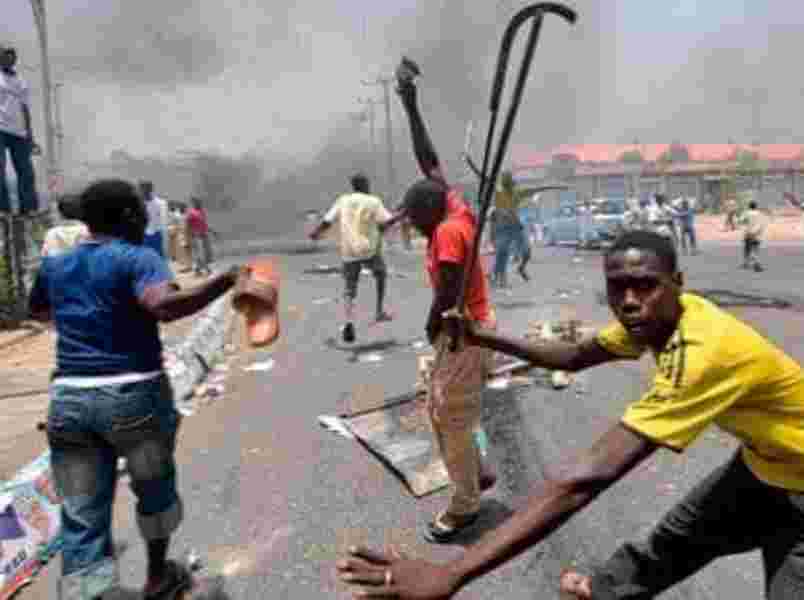
Rampant Incidences of Gunshots, Bloody Physical Attacks, Brazen Thuggery, Intimidation and Electoral Manipulation Raise Fears of An Impending Violent Showdown, as The Ruling APC and The Opposition ADC, NDC And Other Political Parties Mobilize For Power
By Celestine Okafor (Editor-in-chief)
With the election campaigns already kicked-off in earnest by the contesting political parties and their candidates for the various levels of elective positions, the political temperature in the country is gradually rising to combustion.
The political journey towards the 2027 general elections is becoming increasingly clouded by disturbing reports of political intimidation, attacks on opposition gatherings, and counter-attacks against supporters and stalwarts of the ruling party, coupled with destruction of party property including outright threats of violence against political opponents and allegations of electoral manipulation.
Across different parts of the country, political competition is showing signs of degeneration into hostility, with supporters of rival parties increasingly suspicious of one another and the security agencies lacking capacity to guarantee a level playing field.
From Kaduna in the North-West geo-political zone to Enugu in the South-East region, and from the Federal Capital Territory, Abuja to other political battlegrounds, incidents reported in recent weeks raise an uncomfortable question as to whether Nigeria's political parties are actually preparing to compete for the people's votes, or are some of their supporters preparing for a tit-for-tat confrontation that could completely undermine the 2027 elections and the entire political process?
The concern is particularly significant because the ruling All Progressives Congress (APC), the oppositions African Democratic Congress (ADC), the Nigeria Democratic Congress (NDC) and other opposition parties are entering a politically sensitive period in which control of federal and state governments, access to public resources and the future of Nigeria's democracy will be fiercely contested.
The frequency and geographical spread of these reported political incidents is raising urgent concern. Nigeria's 2027 general election, the 8th election in the series since the dawn of this democratic dispensation in 1999, is seemingly degenerating to a contest in which intimidation is substituting for persuasion, and political thuggery replacing campaign volunteers, or the fear of being attacked determines whether citizens will participate in the democratic process.
In Enugu state, for instance, opposition politics came under the shadow of gunfire in one of the most disturbing recent episodes, when supporters of the NDC were reportedly attacked while preparing to welcome their governorship candidate, Mr Chinyeaka Ohaa, on Saturday, October 10, 2026. According to news reports, suspected political thugs disrupted the NDC gathering at the Akanu Ibiam International Airport, Emene, Enugu. The NDC supporters were also allegedly attacked violently at the party's secretariat, where sporadic gunshots were heard during preparations for the governorship campaign flag-off.
Video footages circulated by one of the prominent online newspapers, however, showed supporters of the NDC running helter-skelter for safety, including a badly injured man and vehicles with terribly damaged windscreens. The report also described allegations that security personnel present during part of the incident failed to intervene promptly.
The Enugu State Police Command subsequently ordered an investigation into the alleged shooting outside the NDC secretariat. Police said an injured man, who was reportedly repairing a vehicle nearby, sustained a suspected gunshot wound, while the windscreens of five parked vehicles were terribly damaged. The police also offered a separate account of the airport incident, saying that preliminary findings indicated that restrictions on the number of people permitted to enter the airport area had triggered a misunderstanding that escalated into a fight. The police command however promised to identify and apprehend those responsible for the reported shooting.
The Enugu incident was not isolated. Earlier in September, suspected gunmen reportedly disrupted an NDC ward meeting in a major community in Nkanu West Local Government Area, leaving two attendees critically injured, while a separate gathering organised by the Peoples Democratic Party (PDP) in Agbani, the headquarters of Nkanu West LGA was disrupted and its event canopies and chairs willfully destroyed. Police announced an investigations into the incidents but did not publicly establish the political affiliations of the attackers in their initial statements.
These developments are especially troubling because Enugu has traditionally been associated with competitive politics in which party differences, despite occasional tensions, need not translate into armed confrontations. The emergence of the APC as the ruling party in Enugu state following the defection of it's governor, Dr Peter Ndubisi Mbah from the PDP to the APC, alongside the activities of opposition parties seeking to challenge its dominant position, makes impartial enforcement of the law indispensable.
If political meetings can be disrupted by armed men without prompt identification and prosecution of the perpetrators, opposition supporters may begin to believe that peaceful political participation offers inadequate protection. That perception, whether justified in every individual case or not, can become quite dangerous in this seeming season of political anomie. It may encourage some supporters to organise their own protection groups, provoke retaliatory attacks or abandon lawful channels for resolving political disagreements.
The critical question on the lips of many observers of political events in Enugu, is whether the investigations announced by the police will produce identifiable suspects, ensure credible prosecutions and public explanations of what actually happened.
Without accountability, every new incident risks becoming another grievance in an expanding cycle of political suspicion.
Unlike the Enugu case, however, the opposition is fiercely mobilizing to meet resistance in Kaduna State. Tension also surfaced in late September in Kaduna when the ADC supporters clashed with security operatives during a solidarity walk associated with the party's governorship candidate, Alhaji Isa Ashiru. According to news reports, the confrontation occurred around Murtala Square in Kaduna as supporters gathered for the political activity. The ADC alleged that security operatives and hired thugs had been deployed to disrupt the gathering, an allegation that is yet to thoroughly verified.
The incident illustrates a problem that could become more pronounced as opposition parties attempt to expand their grassroots networks in states where the APC or other established political forces control the machinery of government. A governing party often has an organisational advantage through its existing structures, established networks and party visibility. Based on this reality, the opposition parties are striving hard to demonstrate that they too can mobilise supporters, organise rallies and communicate their political programmes without obstruction, especially by the agents of the ruling party.
Already, issues have arisen as to whether the security agencies have been able to distinguish between legitimate crowd-control measures and actions that unnecessarily restrict lawful political activities. But the common belief within the opposition rank have been that every disagreement with the police constitutes evidence of a government-directed conspiracy against them for political reasons.
Stakeholders and political observers have maintained that security restrictions must be assessed against the law and the circumstances of each political gathering at this campaign period. What the political watchers insist as unacceptable, is the selective application of security measures that tend to protect one political organisation while exposing its opponents to intimidation.
Across the country, there is currently a disturbing pattern of accusations and counter-accusations by political parties and their candidates. The political temperature in the country is already rising beyond Enugu and Kaduna states.
Also, in the same September, the ADC warned that attacks on opposition members and alleged voter intimidation could jeopardise the credibility of the 2027 general elections. The party's national publicity secretary, Bolaji Abdullahi, cited reported incidents across several states, including Kaduna, Kebbi, Ekiti, Cross River, Rivers, Edo, Osun, Kogi and Enugu. The ADC also raised concerns about alleged threats against political opponents and the disruption of opposition activities. Its claims constitute serious allegations that the APC, the government or any particular individual ordered the reported attacks.
The Obidient Movement, associated with the NDC's presidential flagman, Mr Peter Obi subsequently accused the APC of allegedly unleashing violence against opposition supporters in Enugu, Edo, Delta and Benue states. In a report published on Tuesday, October 13, 2026, The Guardian newspaper said the movement accused security agencies of failing to act decisively against suspected political thugs. The allegations had not received a response from the APC or the security agencies at the time of this report.
The wider pattern nevertheless warrants serious concern. When political parties repeatedly accuse one another of intimidation, manipulation and revenge attacks, the public begins to question whether democratic competition is being conducted within an agreed framework of rules. The danger is not simply the violence that has already occurred. It is the possibility that unresolved allegations will be used to justify further confrontation.
The Northern Nigeria presents another important dimension of the unfolding political contest. The anger of voters in the region could easily be channelled into peaceful change. But the APC's governing position at the federal level does not guarantee that northern voters will support its candidates in 2027. Voters in the North-West, North-East and North-Central zones face diverse challenges, including insecurity, displacement, unemployment, rising cost of living and concerns about access to education, healthcare and economic opportunities. These conditions can shape political choices, especially where communities believe that promises made during the previous campaigns have not translated into meaningful improvements.
Opposition parties, including the ADC, the NDC and other political platforms, will seek to convert dissatisfaction into electoral support. Their success, however, will depend on whether they can offer credible candidates, practical policies, effective grassroots organisation and convincing alternatives to the ruling party. The APC, for its part, is yet to recognise that political loyalty cannot be assumed indefinitely. Voters have the constitutional right to withdraw their support from a governing party and transfer it to an opponent. This is evidently the scenario likely to play out at the polls in the 2027 general elections.
The groundswell of opposition from the north is growing by the day. Anger against the President Bola Tinubu administration and his party, the APC, is already budgeoning and dove-tailing into pockets of skirmishes which might blow into full scale violence in the months ahead if desperate interventions are not made to mollify the angst. Opponents of the APC are equally begining to view the electoral strength of the ruling party as a licence to unleash political and violent intimidation against them. But events already unfolding are sufficient hint that the northern voters seem to be preparing for violent confrontation with the APC within their political and geographical jurisdiction.
No doubt, the prevailing reality is that the North isn't politically uniform. Voting preferences differ across the northern states, communities, social groups and individual constituencies. There is the possibility that the present economic frustration and insecurity could be exploited by politicians who portray political opponents as enemies rather than fellow citizens competing for public office. Where political agents offer money, weapons or inducements to young people in exchange for intimidating opponents, an already difficult security environment could deteriorate further.
There is currently a challenge before political leaders to channel voter dissatisfaction into peaceful mobilisation, credible policy debates and lawful electoral participation.
Nigeria, as a matter of historical warning, has seen this movie before. Her
democratic history offers ample evidence of the consequences of political violence.
The 2011 general elections were followed by devastating post-election violence, particularly in parts of northern Nigeria. The 2015 and 2019 election cycles also witnessed serious incidents involving political supporters, candidates and electoral institutions. And the 2023 general elections reinforced the warning that political competition can become dangerous when divisive rhetoric, insecurity and weak accountability combine to pose threats.
A joint election observation report by the International Republican Institute (IRI) and the National Democratic Institute (NDI) recorded 586 election violence incidents and 348 fatalities during the 2023 election cycle, compared with 347 incidents and 224 fatalities during the 2019 cycle. The report also documented attacks on electoral officials and facilities, assassinations and attempted killings, and failures by security agencies to prevent violence in some predictable locations.
Separately, the Armed Conflict Location & Event Data project (ACLED), in a report published ahead of the 2023 elections, recorded more than 200 violent events involving party members and supporters during the preceding 12 months, resulting in nearly 100 reported fatalities. That report identified violence targeting civilians, political supporters and local party officials, alongside threats to election workers and electoral infrastructure.
These figures, however, may not actually reflect or jell with the statistics for the current 2027 pre-election period. Rather, they establish the scale of the danger Nigeria has previously experienced and demonstrate why early warning signs must be taken seriously.
The lesson therein is that electoral violence rarely begins on election day. It can start months earlier with threats, with destruction of party offices, attacks on ward meetings and on political stalwarts and supporters. It could also evidence in inflammatory speeches, the circulation of dangerous rumours and the mobilisation of criminal elements to intimidate opponents.
If these incidents remain unresolved, retaliation or a tit-for-tat engagement could become a political expectation.
In such a scenario of bare-faced political tension, violent threats, safety risks and uncertainty, a party supporter who believes the police will not protect him against party supporter's attacks may seek protection from political patrons. Same as a rival group may interpret that move as preparation for an attack and therefore organise its own violent counter-offensive response. Eventually, political meetings become security operations, while citizens who simply want to hear candidates explain their programmes are forced to calculate the risk of attending such gathering.
The preparations of the major political parties (the APC, ADC and the NDC) will also shape the character of the 2027 elections.
The situation apparent is that the APC, for instance, might enter the election contest with the advantage of being the ruling party at the federal level which controls several state governments in the country. Also, its established political structures, experienced organisers and networks of elected officeholders will equally provide substantial organisational advantages for the party.
The ADC, meanwhile, is seeking to establish itself as a credible opposition platform capable of bringing together dissatisfied voters, influential politicians and supporters of alternative candidates. In the northern states, the scale of grassroots organisation will be particularly important.
Kebbi state, for instance, is where the ADC has fully demonstrated its intention to build a substantial campaign structure. A recent media report said the party's governorship candidate and Nigeria's former Attorney General and Minister of Justice in the Muhammadu Buhari administration, Mallam Abubakar Malami, SAN, inaugurated a 600-member campaign council organised to coordinate activities across the state's 21 local government areas. The report also described the APC's reliance on its existing political structures and campaign networks in the state. These developments demonstrate the organisational competition already taking shape.
The NDC, too, is seeking to establish its presence, particularly in Enugu State, where recent attacks on its activities have highlighted the vulnerability of emerging opposition organisations. The gubernatorial candidate of the NDC in Enugu state, Sir Chinyeaka Ohaa, is currently digging deep to politically unsettle and ultimately displace the incumbent APC governor, Dr Peter Ndubisi Mbah, whose support base in the state can not be easily ignored.
Governor Mbah's political war chest is also huge, and his four year performance scorecard is relatively adjudged to be in line, compared with those of some of his party colleagues in the South East who belong to the politically infant executive leadership class of 2023. Not only that, both major gubernatorial war horses hail from the Nkanu land, a dominant block in Enugu East senatorial district. While Mbah is from the Eastern axis of Nkanu, specifically from Owo town, Chinyeaka, a retired Permanent Secretary in Federal Capital Territory Administration (FCDA) Abuja, comes from the Western Nkanu area of Obuoffia in Awknawnaw town. Chinyeaka who is an old boy of St. Vincent Secondary School, Agbogugu in Awgwu area of Enugu West, is said to have amased an intimidating political networks within Nkanu land and it's key personality figures, a political capital that might work in his favour. He might therefore leverage on this very factor, among many others, to give the governor a hard run at the poll. Although the APC candidate still appears to be standing very strong, courtesy of his incumbency and the support he had garnered in his subsisting tenure. The Nkanu people, especially, would have to make a suitable choice between their two sons, while votes from other axis of the state will become an addendum to decide the ultimate victor.
But Mbah's seeming Achilles heels which might be invoked as a massive political weapon to diminish him at the campaign platforms and in the poll box by his NDC main challenger, Chinyeaka Ohaa, are the yet unexplained mystery figures of his development projects in Enugu state, coupled with some of his touted promised democratic dividends which are yet to be seen in practical terms.
Besides, the Peter Obi factor, a carry-over of political sentiment from the 2023 Labour Party frenzy support, will very likely to be leveraged upon by the NDC and it's flag bearer, Sir Chinyeaka Ohaa. In political reality, Enugu state is predominantly a People's Democratic Party (PDP) political enclave since 1999. On its platform, the incumbent governor, Peter Mbah, rode to power in 2023. But the defection by the governor to the ruling APC, though viewed according to the governor's permutation and perhaps with future political gains in mind and the bogey of bringing Enugu state and the South East zone into the nation's political mainstream, did not actually go down well with a great majority of the Enugu electorates, PDP stalwarts and pro-Mbah political elements. But for the sake of survival politics, everyone had to key in. The reality here is that the APC has never been a darling party in Enugu state. But political convenience and survival has made it part of the maddening crowd of APC associates and sympathisers.
Altogether, Enugu state is most likely to be a fierce battle ground in 2027, essentially between the governing APC and the Peter Obi's NDC, the APC will desperately attempt a push back to retain it's incumbent position. The ruling party's greatest challenge in Enugu would be the Igbo sentiment support for Peter Obi and NDC as expressed in the 2023. Therefore, in a free and fair process, APC will certainly fight to self exhaustion not to suffer displacement.
For all the three major political parties in the 2027 contest, effective preparation will require far more than rallies, campaign vehicles, billboards and the distribution of branded materials and petty food stuffs to vulnerable voters already lacerated by severe economic hardship. They need trained polling agents, credible voter education, legal teams, reliable communications, election monitoring, transparent financing and mechanisms for reporting and resolving disputes. The danger emerges when money and logistics are used not merely to organise a campaign but to create an intimidating show of force.
The evidence of violent engagements in many campaign theatres of conflicts across the geo-political space in the country is not manifest in large convoys of VIP vehicles or heavily guarded political gatherings and the mobilisation of crowds, but when political spending is accompanied by threats, armed escorts acting outside the law or in the recruitment of thugs and purchase of weapons. In such scenario, campaigning and preparing for confrontation becomes dangerously blurred.
There is also a risk that the enormous financial stakes of political office could encourage some candidates to treat elections as investments that must be protected at all costs. Such a mindset often engender vote buying, attempts to manipulate results, intimidation of electoral officials and the deployment of political enforcers against rival parties. To avoid this, the campaign finance rules needs to be enforced rigorously by INEC. The Electoral Act 2026 revised campaign finance provisions and raised spending limits for candidates.
A February 2026 analysis by the Policy and Legal Advocacy Centre highlighted the substantial increases in permitted expenditure and individual donation limits.
But higher legal spending ceilings do not amount to permission for unaccountable expenditure. INEC must therefore ensure that parties and candidates comply with applicable reporting requirements, while financial investigations should examine credible evidence of illegal funding, vote buying and the use of criminal networks.
The public also deserves to know whether campaign funds come from legitimate donations and declared resources or from opaque arrangements that create obligations to powerful sponsors. A political party that spends heavily on winning power should be made to explain how it intends to win the people's confidence and not merely command the streets.
One of the most combustible issues in Nigerian elections is the allegation that results have been manipulated to favour a particular candidate. Disputed results, suspected vote buying, interference with polling agents, ballot snatching and the intimidation of voters can create deep resentment, particularly in communities where electoral competition is close. For the violence level to abate in the coming general elections, political parties should not be allowed to use unproven allegations as an excuse to attack opponents. And election officials equally should not expect citizens to accept questionable processes simply because an official announcement has been made.
The 2027 elections will test the credibility of institutions responsible for conducting, observing and adjudicating electoral disputes. The Independent National Electoral Commission (INEC) has the obligation to provide transparent procedures, credible result management and prompt communication. The security agencies also should be on the alert at all moments, both during the campaign rallies and actual voting, and protect all parties without discrimination. Where there is credible evidence of manipulation, the appropriate response is investigation, preservation of evidence and lawful adjudication, not revenge. Otherwise, Nigeria risks a dangerous tit-for-tat culture in which every alleged offence becomes a justification for another.
As the 2027 election campaigns revs into full gear, experts and poll observers are begining to wonder if the present incidences of violent attacks, inter-party clashes and pockets of mayhem unleashed by party and candidate's supporters are real harbingers of what would happen during the election proper. Nevertheless, the reports are warning signals that all might not be smooth as Nigeria approached the poll days.
However, attacks on political meetings, removal of candidates campaign posters by supporters of opposing parties and outright threats against opponents, including unresolved police investigations and accusations of selective policing, can create an atmosphere in which political actors begin to anticipate confrontation rather than peaceful competition. The greatest danger is that violence may become normalised before the election itself, especially when one party supporters believe that intimidation is necessary to survive politically, restraint becomes harder to maintain. And once political leaders tolerate threats from their own camps while condemning identical conduct by opponents, peace agreements become meaningless.
The 2027 election contest certainly will reveal Nigeria's test of democratic maturity.
However, once the APC demonstrates that incumbency will not be used to obstruct the opposition parties and the ADC, the NDC and other opposition parties also show that their political ambitions can be pursued through lawful mobilisation and credible programmes, the fear of a violent and bloody election exercise would abate. Therefore, the prime obligation before all the political actors, the parties and their candidates, is to eschew thuggery, inflammatory rhetoric and aggressive and retaliatory violence actions.
To avoid a historical repeat or a replay of the 1964 federal elections which ultimately culminated in the circumstances that plunged the entire country into a fratricidal war for two years, there must be concerted efforts by all election stakeholders, the security agency and the media and above all, the nation's electoral ombudsman (INEC) to
avert the prevailing reports of violence before it baloons into a national crisis. The time for preventive action is now, not after lives have been lost.
On its part, the Nigeria Police Force and indeed all other relevant security agencies should investigate reported political attacks promptly and publish credible updates. Investigations should establish the identities of perpetrators, the circumstances of each incident and any evidence of political sponsorship. Anyone found recruiting and financing political thugs should face immediate prosecution. And political leaders, as a matter of responsibility, should restrain their supporters and publicly condemn violence regardless of the party affiliation of the perpetrators.
INEC, consciously should liaise with the media, the security agencies, political parties, civil society organisations and the election observers to identify potential flashpoints and establish effective reporting and response mechanisms. The federal and state governments should ensure that public resources and security institutions are not deployed for partisan purposes. Opposition candidates and their supporters must be able to hold lawful meetings and campaign without intimidation.
Nigerian voters, on their part, should reject the idea that political loyalty requires defending criminal conduct. No candidate's ambition is worth a citizen's life, and no party deserves support merely because its opponents have behaved badly. The country's political leaders must understand that elections are temporary contests for public office, while the consequences of violence can endure for generations. Political violence is a chain, in the sense that the young people recruited to intimidate a rival may become the victim of retaliation next time. While a community that celebrates an attack against one party may discover that the same tactics will later be used against its own members.
There is a choice for the nation to allow political competition to degenerate into a cycle of threats and revenge, or insist that every party submits its ambitions to the discipline of democratic rules. The 2027 elections are fast approaching, but the country still has time to change the trajectory. If political parties continue to tolerate intimidation, celebrate impunity and prepare for confrontation, a tit-for-tat contest could become a self-fulfilling prophecy.
The challenge before the contesting political organisation is to prove that they are preparing to win elections through the people's votes and not through fear. Nigeria's democracy must not become a battlefield where the strongest intimidator wins. It rather should remain a system in which citizens choose their leaders freely and political opponents remain safe, while the electoral victory is determined by the ballot rather than the bullet. NNL.