- Says Government, Press Share Duty To Serve Nigerians As truth Remains Common Ground
By Chinelo Ogbodo (Enugu State Correspondent)
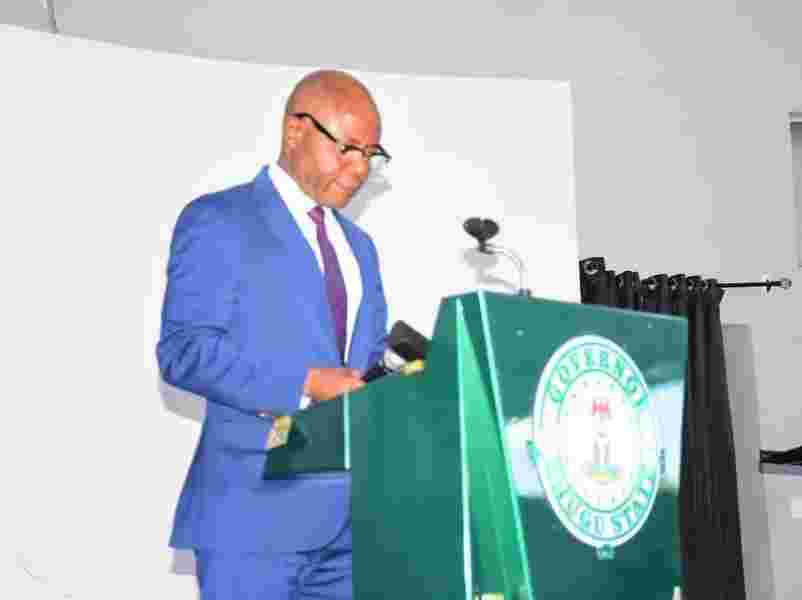
Enugu State Governor, Dr. Peter Mbah, has challenged Nigerian editors to deepen investigative journalism and resist the pull of falsehood in an era where technology can manufacture the appearance of reality.
He declared that government and the press need not always meet “from opposite sides of the barricade.”
Mbah spoke on Tuesday while delivering the welcome remark at the 22nd All Nigeria Editors Conference (ANEC) 2026 holding in Enugu, the second time in two years the Nigerian Guild of Editors has chosen the state to host the gathering of the country’s media leadership.
Addressing more than 300 editors, the governor admitted that standing before the nation’s gatekeepers was “not necessarily the most comfortable position for a governor,” noting that on any other day the same gathering might be scrutinising his decisions. “Today, fortunately, you are our guests. So perhaps we can declare a temporary ceasefire,” he said to laughter.
Themed “The Ballot, the Media and the Task of Keeping Democracy Alive,” with a sub-theme, “When Lies Look Real,” the conference comes amid growing global concern over disinformation and artificial intelligence.
Mbah warned that photographs can now be fabricated, voices cloned and videos manipulated, while allegations can circle the world before a journalist completes a first phone call. He cited the Reuters Institute’s 2026 Digital News Report, which put trust in news among surveyed Nigerian online users at 68 per cent among the highest of 48 markets studied, but cautioned that the Nigerian sample was younger, more urban and more educated than the wider population.
Beyond Nigeria, he said, the picture was sobering: global trust in news has fallen to 37 per cent, the lowest since the institute began measuring it in 2015, while trust in news via social media stands at 22 per cent and in AI chatbot answers at just 20 per cent. He also cited Freedom House’s report that global freedom declined for the twentieth consecutive year in 2025, with media freedom suffering the greatest deterioration in two decades.
“Once a society loses confidence in its ability to establish what is true, the consequences reach far beyond journalism,” Mbah warned. “That makes serious journalism more necessary, not less.”
His challenge to the editors was blunt: “Go deeper.” Investigative journalism, he said, cannot become a luxury, and newsrooms must distinguish between what generates immediate attention and what the public genuinely needs to know.
“Rigorous journalism is not about finding evidence to support a position already taken. Its value lies precisely in its independence: examine the evidence, test competing claims, establish what happened, and report what you find,” he said, insisting the standard must apply equally to government and its critics.
The governor said his administration has tried to build an Enugu government that is open about its actions, adding that where it falls short, scrutiny should follow, but that progress should not become less newsworthy “simply because it doesn’t serve a political narrative.”
Defending his administration’s record, Mbah said Enugu is undergoing one of the fastest and most ambitious transformations in modern Nigeria, with more than 1,500 kilometres of roads constructed or reconstructed, over 7,000 classrooms delivered, Smart Green Schools and Type-2 Primary Healthcare Centres reaching all 260 wards, water returning at scale to Enugu City, new transport terminals and CNG buses, Enugu Air in the skies, and dormant industries coming back to life.
He restated his vision of making Enugu an economic gateway for the South East and one of Nigeria’s top three states by GDP, acknowledging federal support under President Bola Ahmed Tinubu, including increased allocations to states, interventions in roads, aviation, energy and regional development, and the concession of Akanu Ibiam International Airport.
“There is still much to do, and we make no claim otherwise,” he said, inviting the editors to explore the city and see the change for themselves.
He ended with a charge: “Do what good journalism has always done: look closely, establish the facts, and tell the story as you find it. Because as we say in Enugu: Tomorrow is Here!” NNL.