
By Celestine Okafor (Editor-in-chief)
The annual Swedish Nobel Prize Laureate is the dream of, especially, every accomplished literary writer, scientist, Economist, pro-democracy and civil rights activist or pacifist, whether an African, Asian, European, American or the Careabean, etc.
In the month of October every year, however, the world turns its attention to Stockholm and Oslo, the capital cities of Sweden and Norway, as the names of distinguished scientists, writers, economists and champions of peace are announced as recipients of that year's Nobel Prize.
For some of the winners, the announcement crowns decades of their painstaking research or literary brilliance. And for others, it recognises extraordinary courage in the struggle for human rights, democracy and quest for continental or global peace.
Yet behind this celebrated institution, lies a fascinating story of invention, wealth, controversy and an unusual determination to leave for mankind and humanity a better world.
The Nobel Prize was established in 1901 through the will of a Swedish inventor, a physicist and industrialist, Alfred Benhard Nobel. Since then, it has become one of the most prestigious international recognitions of intellectual achievement and service to humanity.
The Nobel Prize began when a Swedish
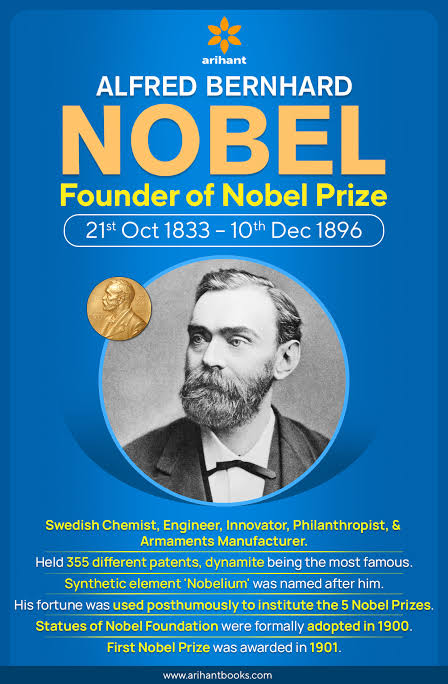
inventor, chemist, engineer and businessman, Alfred Bernhard Nobel who was born in Stockholm, Sweden, in October 21, 1883, turned his fortune into a global legacy. He was a man noted for his scientific ingenuity which made him enormously wealthy.
Alfred Nobel's flagship invention was his production of dynamite (bomb explosives) which he patented in 1867. By making nitroglycerine easier to handle and transport, the invention provided an important tool for mining, quarrying, tunnelling and construction. Mr Nobel's dynamite also contributed to the destructive capabilities of warfare.
Alfred Nobel held more than 350 patents during his lifetime and established businesses and industrial facilities across several countries. His immense wealth, however, became intertwined with a difficult question: what would history remember him for? The man who the wonder of his horror gadget, his invented device, was a threat to the lives of the people of the world and global peace?
May the God of Sweden forbid! The scientific genius quickly devised a smart and better way to placate an aggrieved world. A widely recounted story holds that Mr Nobel was terribly disturbed when a newspaper mistakenly published his obituary following the death of his brother, Mr Ludvig Nobel in 1888. The obituary reportedly portrayed him as a merchant of death because of his invention and association with explosives.
Although the full influence of this episode on his thinking remains uncertain, the story has become an enduring part of the Nobel legend.
Then, on November 27, 1895, Alfred Bernhard Nobel signed his final will at the Swedish-Norwegian Club in Paris, France. He directed that the bulk of his estate should be invested in secure assets, with the income distributed annually as prizes to those who had conferred the greatest benefit on humanity. Later the following year, he died in San Remo, Italy, on December 10, 1896, at a middle age of 63. His will allocated his fortune to five original prize categories: physics, chemistry, physiology or medicine, literature and peace.
Nobel's decision was not immediately implemented. Some members of his family challenged the arrangements, while the scale and international character of his instructions presented practical and legal difficulties. Eventually, the Nobel Foundation was established in 1900 to administer his estate, and the first prizes were awarded in 1901. Alfred Nobel's final act of philanthropy would become one of the most enduring legacies of modern history.
The six categories of the prize was for one enduring ideal. The original Nobel Prizes cover five fields.
The Physics category recognises discoveries that advance understanding of the physical universe, from the smallest fundamental particles and the laws of nature to the largest cosmic structures or astronomy and revolutionary technologies.
The Chemistry category honours and rewards outstanding contributions to understanding the transformation of matter, discoveries concerning the composition, properties, chemical reactions and the molecular processes underpinning modern life and industry. Its contributions have helped advance pharmaceuticals, agriculture, industrial production, materials science and environmental protection.
Physiology or Medicine honours discoveries that advance knowledge of living organisms, improve understanding of diseases or contribute to medical progress.
Literature celebrates outstanding literary achievement, recognising writers whose work makes a significant contribution to the world of letters.
Peace recognises exceptional efforts towards reconciliation, international cooperation, human rights and the peaceful resolution of conflicts.
A sixth category, the Sveriges Riksbank Prize in Economic Sciences set in memory of Alfred Bernhard Nobel himself, was established in 1968 by the Sweden's central bank. It awarded first prize in 1969. Although widely called the Nobel Prize in Economics, it was not one of the five prizes specified in Nobel's will.
The selection process differs according to category. The Royal Swedish Academy of Sciences selects the laureates in physics, chemistry and economic sciences; the Nobel Assembly at Karolinska Institutet selects the medicine laureates; and the Swedish Academy chooses the literature laureate.
The Norwegian Nobel Committee, appointed by the Norwegian parliament, selects the Peace Prize recipient. The division between Sweden and Norway reflects the arrangements Nobel specified in his will.
A full prize currently carries a cash award of 11 million Swedish kronor (Swedish national currency) under the 2025 award level, alongside a gold medal and a personalised diploma. For this year 2026, the prize amount has been increased to 12 million Swedish kronor, which, in the today's Naira exchange rate is N1 billion, six hundred and eleven million, five hundred and sixty nine thousand, three hundred and fifty three naira twenty Kobo (N1,611,569,353.20).
For over a century of the it's existence, October has become the Nobel season every year because the awarding institutions announce their decisions during the month after lengthy evaluation and deliberation.
It is not the month in which the prizes are presented. The actual award ceremonies take place on December 10 each year, the anniversary of Alfred Nobel's death. The ceremonies are held in Stockholm, while the Peace Prize is presented in Oslo. The award/ formal presentation of the medals, diplomas and prizes are done in December while the announcement of prize winners is done
October.
For this year 2026 winners, the announcements ran from October 5 to October 12, producing winners across all the six categories of the prize. The award ceremonies are scheduled for December 10, 2026.
This year's winners for the Physiology or Medicine Prize category went jointly to Karl Deisseroth, Peter Hegemann and Georg Nagel for their discoveries concerning light-gated ion channels and optogenetics, a technique that enables researchers to control the activity of nerve cells using light.
The Physics Prize went to Francis Halzen for his decisive contributions to the IceCube Neutrino Observatory and the discovery of high-energy neutrinos of astrophysical origin.
The Chemistry Prize was awarded to Henri B. Kagan and Kenso Soai for discoveries involving nonlinear effects and autocatalysis in asymmetric organic synthesis.
The Literature Prize went to a Canadian literary writer, Anne Carson, for her innovative body of work, which brings classical traditions into dialogue with contemporary literature. The Peace Prize was awarded to Navanethem "Navi" Pillay, the South African jurist and former United Nations High Commissioner for Human Rights, for her efforts to promote peace and international law. While the Prize in Economic Sciences went jointly to Robert E. Hall and Michael Woodford for their work on the microeconomic foundations of macroeconomic stabilisation.
The selection of Navanethem "Navi" Pillay
is particularly significant for Africa. Her recognition highlights the continent's contribution to international justice and the global struggle to ensure that power does not place individuals or institutions above the law.
The case of Africa and Nobel Prize is a mixed record. The emergence of an African,
Navanethem "Navi" Pillay in this year 2026 has made the foreign award a thing of significant interest for the Africans. Though one may wonder what makes Nobel Prize special? How many Africans, indeed, have won it in over a century of it's debut, and why has the continent struggled to make a greater impression, particularly in science? As the 2026 laureates emerge, these questions deserve fresh attention.
Africa's relationship with the Nobel Prize is, infact, a story of outstanding individual achievements set against a much larger challenge. It is how to translate the continent's immense human potential into sustained global recognition. In the literature category of the Nobel, five writers born in black Africa have won the Prize. They are Professor Wole Soyinka of Nigeria, the first African to be awarded in 1986; Naguib Mahfouz of Egypt, winner in 1988; Nadine Gordimer of South Africa, a recipient in 1991; J. M. Coetzee, born in South Africa, won in 2003; and Abdulrazak Gurnah, born in Zanzibar, now part of Tanzania, winner in 2021.
Wole Soyinka made history as the first African to win the Nobel Prize in Literature. His recognition affirmed the international importance of African dramatic writing, political thought and cultural expression.
Naguib Mahfouz brought the richness of Egyptian society and history to a worldwide audience. Nadine Gordimer and J. M. Coetzee explored the moral complexities and human consequences of apartheid and its legacy. Abdulrazak Gurnah's fiction has examined colonialism, displacement, migration and the fractured identities produced by historical upheaval. Their achievements demonstrate that African experiences can illuminate universal questions about humanity.
The Peace Prize has also recognised several prominent African figures. They include Albert Luthuli, South Africa's anti-apartheid leader, winner in 1960; former slain Egyptian President, Anwar Sadat, jointly with former Israeli Prime Minister, Menachem Begin, won the Nobel Prize in 1978; late South Africa's anti-apartheid activist and Arch-Bishop of South Africa, Desmond Tutu, won in 1984; two former South Africa Presidents, Dr Nelson Mandela and Mr Fredrick .W. de Klerk, jointly won it in 1993; and late Ghanaian diplomat and former Secretary-General of the United Nations, Mr Kofi Annan, won it in 2001.
In 2004, Kenyan female environmental and political activist, Professor Wangari Maathai won in 2004 for her contribution to sustainable development, democracy and peace. In 2011, former Liberian President, Ellen Johnson Sirleaf and peace activist Leymah Gbowee shared the award with Yemen's Tawakkol Karman.
In 2018, Congolese gynaecologist, Denis Mukwege shared the Peace Prize with Nadia Murad of Iraq for their efforts to end the use of sexual violence as a weapon of war. Ethiopian Prime Minister, Abiy Ahmed won in 2019 for his peace initiatives, particularly the reconciliation process with Eritrea. His subsequent political record has, however, illustrated how difficult it can be to sustain peace after an initial breakthrough.
With Navanethem "Navi Pillay's 2026 award, the Peace Prize has recognised 12 African individuals, counting recipients born in or closely associated with African countries and including the two South Africans who shared the 1993 award. The record is not a simple measure of the continent's achievements. Nobel recognition depends on the particular criteria of each award, the work being evaluated and the judgement of the relevant committees.
Nevertheless, it offers a powerful reminder that African leadership in human rights, peace-building and literature has influenced the wider world. But Africa's representation in the scientific Nobel categories remains particularly limited. Among scientists born in Africa who later won Nobel Prizes are South African-born Max Theiler, awarded the Medicine Prize in 1951 for developing an effective yellow fever vaccine; Allan Cormack, born in South Africa and awarded the Physics Prize in 1979 for work that helped lay the foundations of computer-assisted tomography; Sydney Brenner, born in South Africa and awarded the Medicine Prize in 2002; Ahmed Zewail, born in Egypt and awarded the Chemistry Prize in 1999 for his work on femtochemistry; and Michael Levitt, born in South Africa and awarded the Chemistry Prize in 2013.
Their biographies also expose an important complication: birthplace, citizenship, research location and institutional affiliation are not the same thing. Many African-born laureates conducted their most influential research in well-funded institutions outside Africa. Their achievements demonstrate African intellectual potential, but they also raise questions about the research environments available to scientists who remain on the continent.
Africa's scientific challenges include inadequate research funding, poorly equipped laboratories, limited access to advanced technology, unreliable electricity, weak links between universities and industry, and the migration of talented researchers to countries offering better opportunities. These obstacles are not evidence of an absence of African intelligence or creativity. They are reasons for governments and institutions to invest more seriously in science.
Essentially, the Nobel Prize still matters. It's
significance extends beyond its monetary value. The Nobel award gives international visibility to ideas and achievements that may otherwise remain confined to particular countries or academic communities. It can inspire young people to pursue research, writing, humanitarian work and intellectual inquiry. The Prize laureates have helped advance medical treatment, deepen understanding of the natural world, enrich literature and strengthen movements for peace and human rights.
Yet the institution is not beyond criticism. Decisions concerning peace and literature can be controversial, and some selections have attracted debate over political judgement, historical context or the boundaries of merit. There is need for the Nobel Prize to be respected without being treated as an infallible verdict on human achievement. Many remarkable individuals have never received it, and some outstanding contributions fall outside its categories or eligibility rules. Its greatest value lies in its ability to draw attention to work that benefits humanity, not in declaring that only its recipients deserve recognition.
Some African scholars have even asked why the continent cannot establish it's own Nobel Prize? Indeed, there is no reason Africa cannot establish a prestigious, independently administered prize of comparable ambition. The continent could develop a Pan-African award recognising scientific discovery, literature, peacebuilding, public health, agriculture, technological innovation and contributions to African development. Such an institution would need more than generous funding and elaborate ceremonies. It would require a permanent endowment, transparent selection criteria, respected independent juries, international participation, rigorous evaluation and safeguards against political interference.
Governments, universities, philanthropists, businesses and African institutions could contribute to a professionally managed endowment whose investment returns sustain the awards over generations. The prize must not become a reward for political loyalty, a ceremonial honour for powerful individuals or a tool for promoting particular governments. Its credibility would depend on independence and excellence.
However, it would be a good idea if Africa will continue to engage with the existing Nobel system, strengthening its universities, protecting academic freedom, funding original research and creating conditions that allow talented scholars to build their careers at home. A continental prize, therefore, would complement, not replace, these responsibilities.
More than a century after the first Nobel Prizes were awarded, Alfred Nobel's decision to devote his fortune to human advancement remains an extraordinary act of philanthropy.
His legacy is not merely a gold medal or a substantial financial reward. It is the enduring proposition that scientific discovery, literary imagination and the pursuit of peace deserve society's highest recognition.
For Africa, however, the challenge is two-fold. We need to celebrate the achievements of our Nobel laureates and also build the institutions that will enable many more Africans to compete at the highest international level. The continent has no shortage of brilliant minds, courageous peacebuilders, gifted writers or problems demanding innovative solutions. What it needs is sustained investment, stronger institutions and a culture that rewards excellence rather than patronage.
Perhaps the most fitting tribute Africa can pay to Nobel's legacy is not simply to dream of producing more laureates, but to create a society in which knowledge is valued, discovery is encouraged and human dignity is protected. That, ultimately, is the prize worth giving. NNL.